About Agave shawii Engelm.
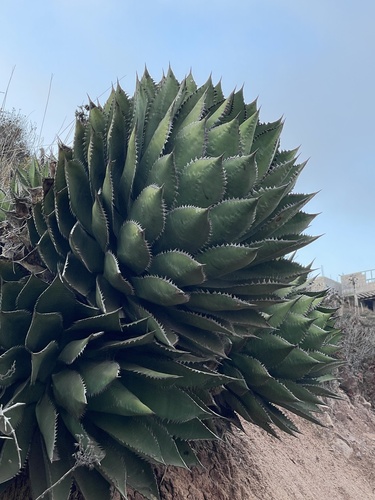
Agave shawii Engelm. is a very slow-growing small-to-medium-sized agave. Its foliage grows in a rosette 8 centimeters (3.1 inches) to 2 meters (6.6 feet) wide. Numerous rosettes may grow on erect to decumbent trunks that emerge from the rootstock. The glossy foliage ranges from light to dark green, and grows in an ascending arrangement. Leaves are narrow to ovate, 20–50 cm (7.9–19.7 in) long by 8–20 cm (3.1–7.9 in) wide, with a convex lower (abaxial) surface. Leaves are thick, fleshy, rigid, and have colorful, well-defined spines along their margins. The terminal spine at the leaf tip is 2–4 cm (0.79–1.57 in) long.
The panicle-like inflorescence grows 2–4 m (6.6–13.1 ft) tall. The bracts (inflorescence leaves) are persistent, shaped lanceolate to triangular, and measure 10–25 cm (3.9–9.8 in). Each bract subtends 8–14 lateral umbel branches, which are 10–20 cm (3.9–7.9 in) long. Each umbel holds a cluster of 35–75 yellowish or reddish flowers. After flowering, the plant produces fruits 5.5–7 cm (2.2–2.8 in) in size, containing both black fertilized seeds and white unfertilized seeds. Flowering generally occurs from September to May, and as is typical for agaves, the rosette dies after flowering. While this species can reproduce through suckering, population growth habits vary widely: some populations consist entirely of individual rosettes, while others form groups or clonal colonies.
This species is primarily distributed in, and near-endemic to, the Mexican state of Baja California. It was formerly widespread along the coast of San Diego County, California, but coastal development has reduced the entire native population there to just two natural occurrences, only one of which is fully natural. A 25 km (16 mi) north-to-south gap separates the southernmost natural plants in San Diego County from the northernmost natural plants in Baja California. The coastal subspecies A. shawii subsp. shawii is the taxon found in San Diego County, and ranges south to El Rosario in Baja California. At El Rosario, it is replaced by the desert subspecies A. shawii subsp. goldmaniana, which ranges south into the desert to Santa Rosaliíta in southern Baja California.
Subspecies shawii occurs only in the maritime succulent scrub vegetation community, found along the Pacific Coast of northern Baja California, Mexico and the extreme southwestern part of San Diego County, California. This habitat extends only a few kilometers into the United States, forming narrow bands on coastal bluffs that are almost constantly exposed to salt-heavy coastal winds. Maritime succulent scrub is considered the driest type of coastal sage vegetation, and is dominated by other succulent plants including cacti (Bergerocactus, Cylindropuntia, Ferocactus, Mammilaria, Opuntia), cliff spurge (Euphorbia misera), and Crassulacean plants such as Dudleya. Subspecies shawii was likely once found north of Torrey Pines, but development of all suitable habitat has left it nearly extinct on the American side of the border.
Agave shawii is cultivated as an ornamental plant by specialty plant nurseries. It is used in cactus and succulent gardens, containers, drought-tolerant gardens, and wildlife gardens. This species grows best in sandy loam soil with good drainage. It is recommended to plant it in a location where its sharp spines do not pose a hazard. The plant is virtually disease-free, with only occasional infestations of scale insects. Its roots respond very quickly to rain; dry plants begin growing feeder rain roots after exposure to rain. Plants develop their best color when grown in full sun along the coast. For inland valley cultivation, best results are achieved with partial shade to provide relief from hot afternoon sun. Within the United States, it is not recommended for cultivation in desert locations such as Las Vegas, but it thrives in coastal locations from San Diego to San Francisco.
As part of preservation efforts, Shaw's agave has been introduced to Torrey Pines State Natural Reserve and Cabrillo National Monument in San Diego, California, where populations have become established. A large colony of Shaw's agave also grows at San Diego Botanic Garden in Encinitas, California. Shaw's agave is also planted in the California native plant xeriscaping at the San Elijo Lagoon Nature Center in Encinitas.