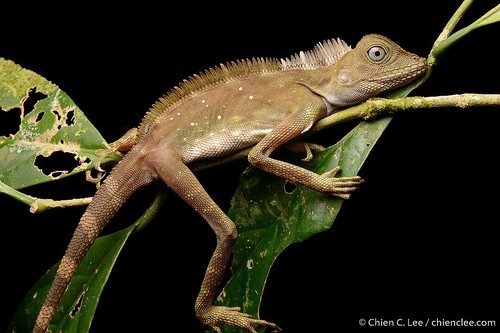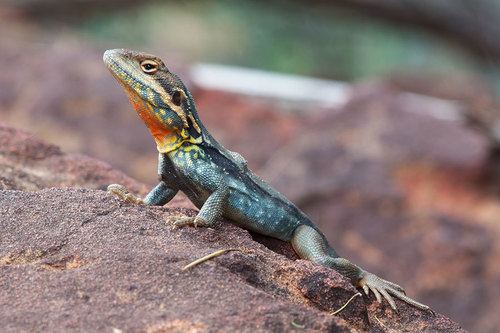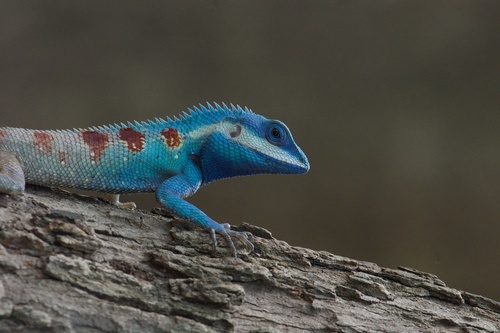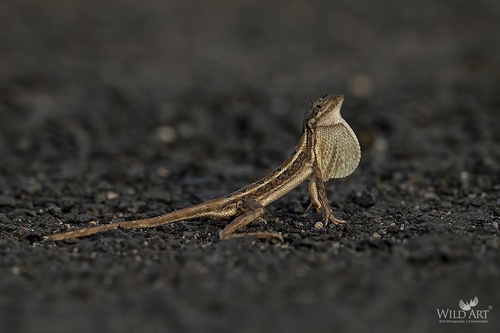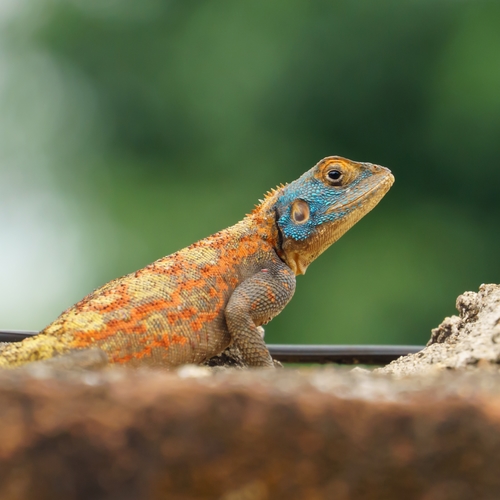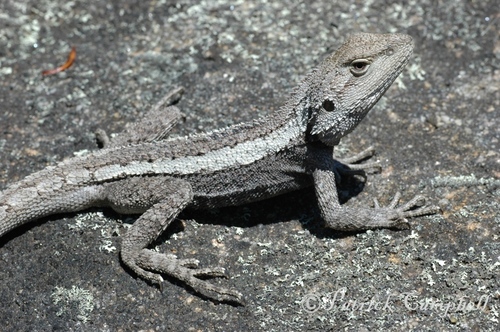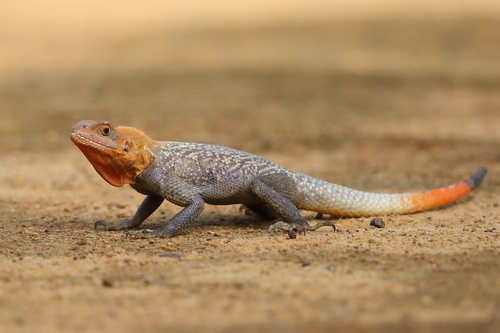
About Agama agama (Linnaeus, 1758)
Total Length Range
Agama agama (Linnaeus, 1758) ranges from 13 to 30 cm (5.1 to 11.8 in) in total length. Males are typically 7.5 to 12 cm (3.0 to 4.7 in) longer than the average female.
Coloration Features
This agama lizard can be identified by a white underside, brown back limbs, and a tail with a light stripe running down its middle. The tail stripe usually has around six to seven dark patches along its side.
Sexual and Age Color Differences
Females, adolescent lizards, and subordinate males have an olive green head, while dominant males have a blue body and a yellow tail.
Native Distribution
The common agama is endemic to Benin, Burkina Faso, Cameroon, Cape Verde, Chad, Equatorial Guinea, Gabon, The Gambia, Ghana, Guinea, Guinea-Bissau, India, Ivory Coast, Kenya, Liberia, Madagascar, Mali, Mauritania, Niger, Nigeria, Senegal, Sierra Leone, Togo, Tanzania, and Uganda.
Introduced Range
It has been introduced to southern Florida via the reptile trade, where it has become extremely common.
Arid Adaptation
Agama agama is well-adapted to arid conditions.
Activity Pattern
These lizards are active throughout the day, except during the hottest hour, when even shaded spots can reach 38 °C (100 °F).
Sexual Maturity Age
Females reach sexual maturity at 14 to 18 months old, while males take 2 years to mature.
Reproduction Season
Agama agama generally reproduces during the wet season, but can also reproduce in areas that receive constant rainfall.
Egg Laying Site Preparation
After fertilization, when the female is ready to lay eggs, she digs a 5 cm (2 in) deep hole with her snout and claws in damp, sandy soil. This soil is covered by grasses or other plants, and receives sunlight for most of the day.
Egg Clutch and Incubation
After digging is complete, the female lays a clutch of 5 to 7 ellipsoidal eggs that hatch within 8 to 10 weeks.
Embryo Sex Determination
The sex of common agama embryos is determined by temperature: all male embryos develop at a temperature of 29 °C (84 °F), while female embryos develop in the 26–27 °C (79–81 °F) range.
Hatchling Size
After hatching, offspring measure approximately 3.7 cm (1.5 in) from snout to vent, with an additional 7.5 cm (3.0 in) tail.