About Adenanthos cuneatus Labill.
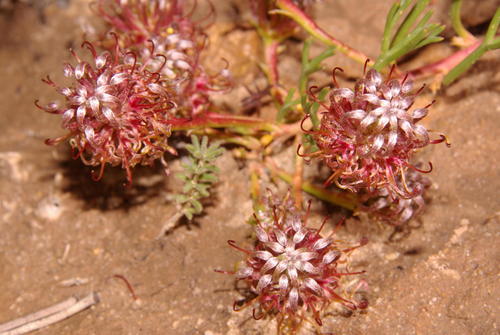
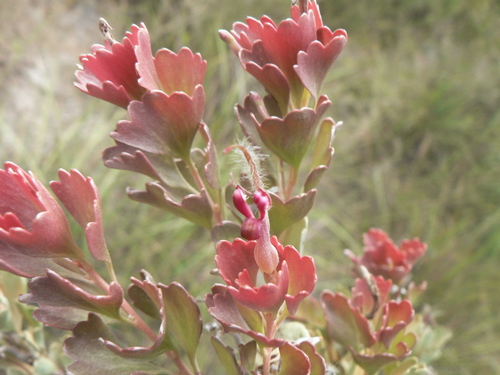
Adenanthos cuneatus Labill. grows as an erect, spreading, or prostrate shrub, reaching up to 2 m high and 2 m wide. It has a woody lignotuber at its base that allows it to resprout after bushfire. Its wedge-shaped (cuneate) leaves sit on short petioles, measuring 2 cm long and 1–1.5 cm wide, with 3 to 5, and occasionally up to 7, rounded teeth or lobes at the leaf tip. New growth is red, slightly translucent, and glows bright red when backlit, especially when the sun is low; it mainly appears in summer. All leaves are covered in fine, silvery hair. Single, dull red, inconspicuous flowers around 4 cm long appear throughout the year, but most often between August and November. Its pollen is triangular, measuring 31–44 μm in length, with an average of around 34 μm. This species is closely related to and similar to Adenanthos stictus, with several clear differences. A. cuneatus is multi-stemmed, lignotuberous, and rarely grows taller than 2 m, while A. stictus is a taller, single-stemmed, non-lignotuberous shrub that commonly reaches 5 m in height. Leaf lobes at the apex of A. cuneatus are regular and rounded (crenate), whereas leaf lobes on A. stictus are irregular and toothed (dentate). A. stictus does not produce red new growth, and its juvenile leaves are usually much larger than its adult leaves, a difference not seen in A. cuneatus. The flowers of the two species are very similar, with only subtle differences in size, colour, and hair covering. As the most widely distributed Adenanthos species along the south coast, A. cuneatus is common and locally abundant between King George Sound and Israelite Bay, occurring along the coast and up to 40 km inland. Isolated populations extend further west to Walpole and the Stirling Range, and further east of Israelite Bay to Twilight Cove. This species is restricted to deep siliceous sandplain soils; it will not grow in calcareous soils such as the limestone plains of the Nullarbor, nor in siliceous dunes with limestone at shallow depth. This soil restriction explains the disjunct populations east of Israelite Bay, where the species only occurs in the few locations with suitable cliff-top dunes of deep siliceous sand. When growing on siliceous, fairly dry soil, A. cuneatus tolerates a range of other soil conditions: it grows in both lateritic sand and marine-origin sand, and tolerates pH levels from 3.8 to 6.6. Consistent with these preferences, A. cuneatus is a frequent, characteristic member of kwongan heathlands found on the sandplains of Southwest Australia. The climate across its range is mediterranean, with annual rainfall between 275 and 1,000 mm. Ecological interactions with A. cuneatus include visits to its flowers from colletid bees of the genus Leioproctus. A 1978 field study around Albany found that honey possums (Tarsipes rostratus) occasionally visit the species, while western spinebills much prefer A. cuneatus over other flowers. A 1980 field study at Cheyne beach found that New Holland honeyeaters and white-cheeked honeyeaters pollinate the species. A 1985–86 field study in Fitzgerald River National Park recorded that nectar-feeding honey possums occasionally feed on it. Silvereyes (Zosterops lateralis) feed on its flower nectar, and have also been observed taking dew drops from its leaves early in the morning. A. cuneatus is known to be susceptible to Phytophthora cinnamomi dieback, but reported susceptibility ranges from low to high. A 16-year study of Banksia attenuata woodland 400 km southeast of Perth, conducted following a wave of P. cinnamomi infestation, found no significant reduction in A. cuneatus populations in diseased areas. Phosphite, a compound used to combat dieback, causes some leaf tip necrosis and has mild toxic effects in A. cuneatus, but the shrub absorbs very little of the compound compared to other shrubs. Between a quarter and half of exposed A. cuneatus specimens in coastal dune vegetation succumb to the fungus Armillaria luteobubalina, showing some sensitivity to this pathogen. A. cuneatus was introduced to Great Britain in 1824, and is now grown in cultivation in Australia and the western United States. Its main horticultural attractions are its attractive bronzed or reddish foliage and its ability to attract birds to gardens. It grows best in a well-drained position, tolerates full sun or semi-shade, and grows well in both sand and gravelly soils. Western Australian nurseryman George Lullfitz recommends growing it as a rambling ground cover in front of other shrubs, or in a rockery. Two cultivars are available: 'Coral Drift' is a compact form that has been in cultivation since at least the 1990s, growing 50–70 cm tall and 1–1.5 m wide, with grey foliage and pinkish purple new growth. 'Coral Carpet' is a prostrate form that reaches a maximum height of around 20 cm and spreads 1.5 m across, with pinkish purple new growth. It originated as a chance seedling from 'Coral Drift', originally developed by George Lullfitz of Lullfitz Nursery in Wanneroo. It became publicly available in 2005 and has been successfully registered under Plant Breeders' Rights.