About Adansonia grandidieri Baill.
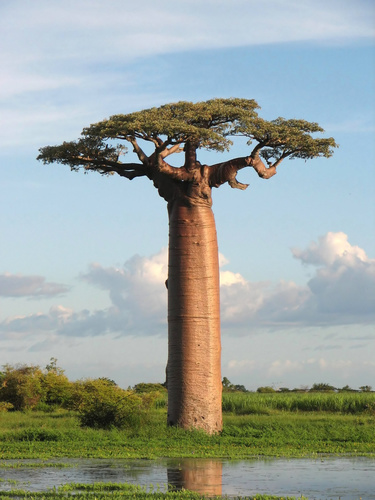
Grandidier's baobab, scientifically named Adansonia grandidieri Baill., has massive, thick cylindrical trunks that can grow up to three meters across. Its trunk is covered in smooth, reddish-grey bark, and mature trees reach a total height of 25 to 30 m (82 to 98 ft). The tree has a flat-topped crown with horizontal main branches. This baobab is native to south-western Madagascar, where it grows between Lake Ihotry (near Morombe) and Bereboka. Historically, it inhabited dry deciduous forest, most often near seasonal rivers or lakes, but today it is primarily found in open agricultural land and degraded scrubland. As a long-lived species, Grandidier's baobab produces leaves from October to May, and flowers between May and August. Its flowers, noted to have a scent similar to sour watermelon, open just before or shortly after dusk, and release all of their pollen within the first night. The tree is pollinated by nocturnal mammals including fork-marked lemurs, and by insects such as the Hawk Moth. When lemurs move through the tree canopy, they insert their snouts into the tree's white flowers to lick nectar from the base of the petals, which leaves pollen deposited on their faces. Hawk Moths are slightly more effective pollinators, since they fly between individual trees with most of their bodies covered in pollen. Ripe fruit is produced by the species during November and December. Unlike baobab species found in Africa and Australia, animal dispersal of the tasty fruit's seeds has not been observed for Adansonia grandidieri. While lemurs are the only living native Malagasy animals large enough to act as seed dispersers for this species, seed dispersal by lemurs has never been documented. This may have been different in the past, when several large seed-dispersing species were still present before going extinct after humans colonized Madagascar 1,500 to 2,000 years ago. These extinct potential dispersers include baboon-like primate species, and the elephant bird, the heaviest known bird to have ever lived, which had a strong beak capable of opening large fruit. At present, water is the most likely agent of seed dispersal for this species. To cope with periodic lack of water in its native range, Grandidier's baobab stores water in the fibrous wood of its trunk, and the trunk's diameter changes in response to rainfall. It is the most commonly used baobab species in Madagascar. The vitamin C-rich fruit pulp and seeds are eaten fresh, and cooking oil is extracted from the oil-dense seeds. Fruit is collected either from the ground, or by climbing the tree after hammering wooden pegs into the trunk to create hand and foot holds. The thick bark of the tree is made up of tough long fibers that can be processed into rope, and most wild trees bear scars from bark harvesting that extends from ground level up to around two meters up the trunk. Fibrous sheets of spongy wood are harvested from both dead and living trees, dried in the sun, and sold for use as thatch. Most of these uses do not require killing the tree, so they do not pose a major threat to Grandidier's baobab populations.