About Aconitum columbianum Nutt.
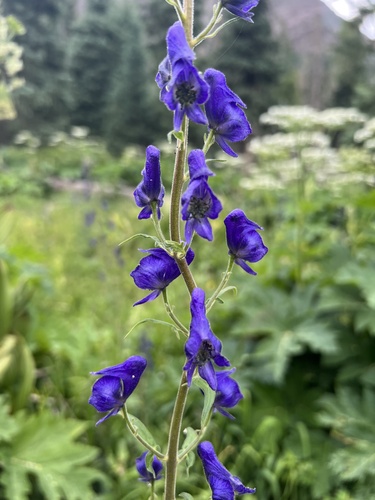
Aconitum columbianum Nutt. is a herbaceous perennial plant that grows from a large, spindle-shaped tuber-like root. Its stems reach 20 to 300 centimeters in height, and are either erect or trailing. Stem-attached leaves usually have 3–5 deep divisions extending almost to the leaf base, and can have as many as 7 divisions. Approximately 2 millimeters of leaf tissue remains between the point where the leaf attaches to the stem and the deepest point of each division. Each leaf segment has toothed or cleft edges, and individual leaves measure 5 to 15 centimeters wide. Its flowering inflorescence is either an unbranched raceme holding multiple flowers or a branched panicle. Flowers are most commonly blue, but may occasionally be white, cream, or white with a faint blue tint along sepal margins. Flower size varies: the distance from the top of the upright hood sepal to the tips of the two downward-pointing sepals measures 18 to 55 millimeters. The two pendulous hanging sepals measure 6 to 16 millimeters. The prominent hood sepal ranges in shape from rounded to conical to crescent-shaped, and measures 10 to 34 millimeters from its base where it connects to the stem to its top. Fruits are dry, pod-like follicles that are 10 to 20 millimeters long. Like all other monkshoods in the genus Aconitum, Aconitum columbianum is poisonous to humans and livestock, even though some Aconitum species have been used to make drugs. Aconitum columbianum grows across the western United States, from the west coast through the Rocky Mountains. It is also found in parts of British Columbia and South Dakota, and has been reported growing in Iowa, Wisconsin, New York, and the Mexican states of Sonora and Chihuahua. In 2016, NatureServe rated Aconitum columbianum as globally secure (G5), and additionally rated it vulnerable at the state level (S3) in Wyoming. Western monkshood is sometimes cultivated in gardens for its dramatic dark purple-blue flowers. It requires moist, rich soil, and shade in all but the mildest climates.