About Acinonyx jubatus (Schreber, 1775)
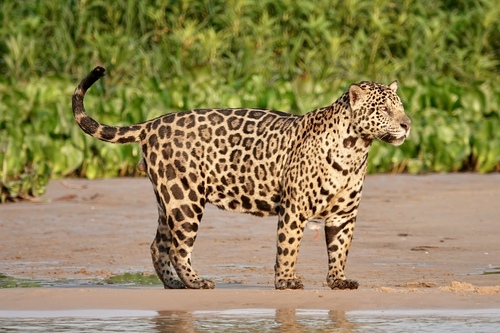
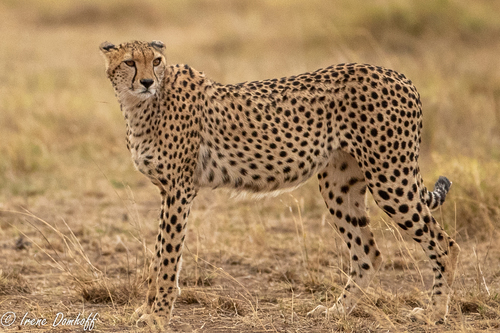
Characteristics The cheetah (Acinonyx jubatus) is a slim-bodied, spotted cat with a small, streamlined head, short snout, black tear-like facial streaks, deep chest, long limbs, and a long tail. Its slender, canid-like body shape is highly adapted for running, and contrasts sharply with the bulky bodies of members of the Panthera genus and cougars. Cheetahs typically stand 67–94 cm (2.20–3.08 ft) at the shoulder, with a head-and-body length between 1.1 and 1.5 m (3 ft 7 in and 4 ft 11 in). Adult weight varies by age, health, location, sex, and subspecies, and typically ranges between 21 and 65 kg (46 and 143 lb). Wild-born cheetah cubs weigh 150–300 g (5.3–10.6 oz) at birth, while captive-born cubs tend to be larger, weighing around 500 g (18 oz). The cheetah is sexually dimorphic, with females averaging smaller than males. Studies report significant disagreement on morphological variation between subspecies. The cheetah's coat is typically tawny to creamy white or pale buff, and is darker along the mid-back. The chin, throat, underparts of the legs, and belly are white and free of markings. The rest of the body is covered in around 2,000 evenly spaced, oval or round solid black spots, each roughly 3–5 cm (1.2–2.0 in) across. Each cheetah has a unique spot pattern that can be used to identify individual animals. In addition to the clearly visible spots, the cheetah's coat also has faint, irregular black marks. Newly born cubs are covered in fur with an unclear spot pattern that gives them a dark overall appearance, with pale white fur on the upper body and nearly black fur on the underside. Most cheetah fur is short and often coarse, but the chest and belly are covered in softer fur; the fur of king cheetahs has been reported to be silky. Cheetahs have a short, rough mane that covers at least 8 cm (3.1 in) along the neck and shoulders, and this feature is more prominent in males. In juvenile cheetahs, the mane starts as a cape of long, loose blue to grey hair. Melanistic cheetahs are rare and have been observed in Zambia and Zimbabwe. Two partially albino cheetah specimens from South Africa were described in 1877–1878. A tabby cheetah was photographed in Kenya in 2012. Saharan cheetahs have canid-like slim faces. Cheetah ears are small, short, and rounded; they are tawny at the base and edges, with black patches on the back. The eyes are set high and have round pupils. The distinctive tear streaks are unique to cheetahs, starting at the corners of the eyes and running down the nose to the mouth. The function of these streaks is not well understood, but they may protect the eyes from the sun's glare or help define facial expressions. Cheetah whiskers are shorter, fewer in number, finer, and less conspicuous than those of other felids. The long tail, which has a bushy white tuft at its end, measures 60–80 cm (24–31 in). While the first two-thirds of the tail are covered in spots, the final third has four to six dark rings or stripes. Although leopards look similar to cheetahs at first glance, leopards have rosettes rather than solid spots and do not have tear streaks. Servals also resemble cheetahs, but their spots fuse to form stripes on the back. Distribution and habitat In eastern and southern Africa, cheetahs occur mostly in savannas such as the Kalahari and Serengeti. In central, northern, and western Africa, they live in arid mountain ranges and valleys; in the harsh climate of the Sahara, they prefer higher mountains that receive more rainfall than the surrounding desert. The vegetation and water resources in these mountains support antelope populations. In Iran, cheetahs occur in hilly desert terrain at elevations up to 2,000–3,000 m (6,600–9,800 ft), where annual precipitation is generally below 100 mm (3.9 in); the primary vegetation in these areas is thinly spaced shrubs less than 1 m (3 ft 3 in) tall. Cheetahs live in a variety of ecosystems and appear to be less selective about habitat than other felids; they prefer areas with higher prey availability, good visibility, and minimal chance of encountering larger predators. They rarely occur in tropical forests. Cheetahs have been recorded at elevations up to 4,000 m (13,000 ft). An open area with some cover, such as scattered bushes, is likely ideal for cheetahs, as they need to stalk and chase prey over distance. This environment also minimizes the risk of encountering larger carnivores. Cheetahs typically occur at low population densities, ranging from 0.3 to 3.0 adults per 100 km2 (39 sq mi); these values are 10–30% of the densities reported for leopards and lions. Historical range In prehistoric times, cheetahs were distributed across Africa, and Western and Central Asia. Today, cheetahs have been extirpated from most of their historical range; Asiatic cheetah numbers began dropping sharply in the late 1800s, long before other subspecies began to decline. As of 2017, cheetahs only occur in nine percent of their former range in Africa, mostly in unprotected areas. Until the mid-20th century, cheetahs ranged across large areas of Asia, from the Arabian Peninsula in the west to the Indian subcontinent in the east, and as far north as the Aral and Caspian Seas. A few centuries ago, cheetahs were abundant in India, and their range matched the distribution of major prey species such as the blackbuck. However, cheetah numbers in India plummeted starting in the 19th century; the last three wild individuals were killed by Maharaja Ramanuj Pratap Singh of Surguja in 1947. The last confirmed cheetah sighting in India was of an individual that drowned in a well near Hyderabad in 1957. In the Soviet Union, the cheetah's range included the "desert plains of Middle Asia and southern Kazakhstan and the eastern Trans-Caucasus". During the Middle Ages, cheetahs ranged as far as western Georgia, and probably survived in the Kura-Aras lowland and central Aras River valley until the 18th century. They went extinct in the region after goitered gazelle populations declined and due to human persecution. By the mid-20th century, cheetahs were reported to still be quite extensively, if sparsely, distributed across the region west of the Amu Darya and Aral Sea, but were vanishing very rapidly. In Iraq, cheetahs were reported in Basra in the 1920s. Before World War II, there were around 400 cheetahs in Iran, distributed across eastern deserts and steppes and western borderlands with Iraq; numbers fell due to declining prey populations. Conservation efforts in the 1950s stabilized the population, but after the 1979 Iranian Revolution and the Iran–Iraq War, prey species declined again, leading to significant contraction of the cheetah's historical range in the region. In 1975, the first survey of Sub-Saharan African cheetahs conducted by Norman Myers estimated the regional population at 15,000 individuals. At that time, the range covered most of eastern and southern Africa, except for the desert region on the western coast of modern-day Angola and Namibia. In the years following this survey, cheetah populations across the region have become smaller and more fragmented as natural habitat has been significantly modified. Cheetah mummies dating to 4223–127 YBP have been found in a cave system in Saudi Arabia. Present distribution Cheetahs occur mostly in eastern and southern Africa; their presence in Asia is restricted to the central deserts of Iran, though there have been unconfirmed reports of sightings in Afghanistan, Iraq, and Pakistan over the last few decades. In 2016, the global cheetah population was estimated at nearly 7,100 mature individuals. The Iranian population decreased from an estimated 60 to 100 individuals in 2007 to 43 individuals in 2016, distributed across three subpopulations over less than 150,000 km2 (58,000 sq mi) on Iran's central plateau. The largest cheetah population, with nearly 4,000 individuals, is sparsely distributed across Angola, Botswana, Mozambique, Namibia, South Africa, and Zambia. A second population in Kenya and Tanzania includes around 1,000 individuals. All other cheetah populations are small, fragmented groups of fewer than 100 individuals each. Cheetah populations are thought to be declining. Ecology and behaviour Cheetahs are active mainly during the day, while competitors such as spotted hyenas and lions are active mainly at night. These larger carnivores can kill cheetahs and steal their kills, so the diurnal activity pattern helps cheetahs avoid larger predators in areas where they share the same range, such as the Okavango Delta. In areas where cheetahs are the main predator (such as farmlands in Botswana and Namibia), activity tends to increase at night. This can also happen in highly arid regions such as the Sahara, where daytime temperatures can reach 43 °C (109 °F). The lunar cycle can also affect cheetah activity patterns: activity may increase on moonlit nights because prey is easier to spot, though this also increases the risk of encountering larger predators. Hunting is the main daily activity, with activity peaks at dawn and dusk. Groups rest in grassy clearings after dusk. Cheetahs often check their surroundings from elevated observation points to look for prey or larger carnivores; even while resting, they take turns keeping watch. Reproduction and life cycle Cheetahs breed year-round; females are polyestrous induced ovulators with an average estrous cycle of 12 days, which can range from three days to a month. Females have their first litter at two to three years of age, and can conceive again 17 to 20 months after giving birth, or even sooner if an entire litter is lost. Males can breed before two years of age in captivity, but this may be delayed in the wild until the male gains a territory. A 2007 study found that females that gave birth to more litters early in life typically died younger, indicating a trade-off between longevity and yearly reproductive success. Male urine marking becomes more noticeable when a female nearby enters estrus. Males, sometimes even those in coalitions, fight one another to gain access to females. Often one male eventually wins dominance over the others and mates with the female, though a female may mate with multiple males. Mating begins when the male approaches the female, who lies down on the ground; individuals often chirp, purr, or yelp at this stage. No extended courtship behaviour is observed; the male immediately holds the female's nape, and copulation occurs. The pair then ignores each other, but meet and copulate three to five times a day over the next two to three days before finally separating. After a gestation period of nearly three months, a litter of up to six to eight cubs is born, though litters of three to four cubs are more common. Cheetah litters tend to be larger than those of most felid species. Births occur at 20–25 minute intervals in a sheltered location such as thick vegetation. Cubs are born with their eyes closed, which open four to 11 days after birth. Newborn cubs may spit frequently and make soft churring sounds; they begin walking by two weeks of age. Their nape, shoulders, and back are thickly covered with long bluish-grey hair called a mantle, which gives them a mohawk-like appearance; this fur is shed as the cheetah matures. One study suggests this mantle makes cheetah cubs resemble honey badgers, and may act as camouflage to protect them from attacks by badgers or predators that avoid honey badgers. Mothers keep their cubs hidden in dense vegetation for the first two months and nurse in the early morning. The mother is extremely vigilant during this period; she stays within 1 km (0.62 mi) of the den, visits her cubs frequently, moves the den every five to six days, and stays with the cubs after dark. Despite trying to make as little noise as possible, she generally cannot defend her litter from predators. Predation is the leading cause of cub death; in the Serengeti, 58.3% of total cub deaths are due to predators, and the rate is 88.9% in the Kgalagadi Transfrontier Park. Cub deaths also occur from starvation if the mother abandons them, fires, or pneumonia caused by exposure to bad weather. The generation length of the cheetah is six years. The overall juvenile survival rate is 35.7% in the Kgalagadi Transfrontier Park and 34.3% in the Kalahari Desert, compared to a 37% juvenile survival rate for leopards in the Sabi Sand Game Reserve; high juvenile mortality appears to be a natural part of predator population dynamics. Cubs begin leaving the den at two months of age, following their mother wherever she goes. At this stage, the mother nurses less and brings solid food to the cubs; they initially retreat away from the carcass out of fear, but gradually begin eating. Cubs may purr while their mother licks them clean after feeding. Weaning occurs at four to six months. To train her cubs to hunt, the mother will catch live prey and release it in front of the cubs. Cub play behaviour includes chasing, crouching, pouncing, and wrestling; play involves a great deal of agility, and attacks are rarely lethal. Play can improve cubs' catching skills, though the ability to crouch and hide may not develop notably. Cubs as young as six months old attempt to capture small prey such as hares and young gazelles. However, they may not make a successful kill on their own until they are as old as 15 months. At around 20 months, offspring become independent; mothers often have already conceived again by this time. Siblings may stay together for a few more months before separating. Females stay close to their mother's range, while males move farther away. In the wild, female cheetahs live 14 to 15 years, and their reproductive cycle typically ends by 12 years of age; males generally live up to ten years.