About Acianthus exsertus R.Br.
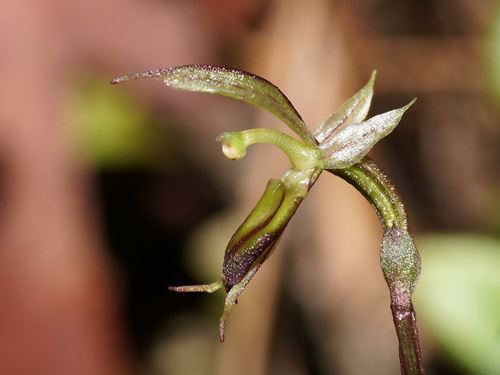
Acianthus exsertus R.Br. is a terrestrial, perennial, deciduous, sympodial herb that grows a single heart-shaped, hairless leaf. The leaf is dark green on the upper surface and reddish-purple on the lower surface, measuring 15–40 mm long and 10–30 mm wide. This species produces between 3 and 25 well-spaced flowers on a thin raceme that grows 100–300 mm tall; each individual flower is 12–16 mm long. The dorsal sepal is linear to egg-shaped, 7–9 mm long and 3 mm wide, ending in a 2–3 mm long point. It has a red central stripe and forms a hood that only partially covers the flower's column. The lateral sepals are 8–9 mm long, 1 mm wide, linear to narrow lance-shaped, ending in a 2–3 mm long tip. They project forwards, either parallel to each other or diverging. The petals share a similar color to other floral parts, measuring 4–5 mm long and about 1 mm wide. They are linear to narrow egg-shaped and curve towards the ovary. The labellum is 5–6 mm long and 3.5–4 mm wide, shaped from heart-shaped to elliptic. It is dished near the base, with edges rolled under and no teeth present on the edges. A thick, fleshy callus on the labellum is covered in many small pimple-like papillae across its outer half. Flowering for this species occurs from March to August. It can be distinguished from other mosquito orchids by its relatively large, well-spaced dark-colored flowers, and by a dorsal sepal that does not fully cover the column. This orchid is widespread and locally common across eastern Australia. It grows in sheltered forest and woodland in well-drained soil; it is sometimes found in coastal areas, but occurs most often on ranges and tablelands. In Queensland, it occurs as far north as Rockhampton. In New South Wales, it is found in most coastal and tableland regions, and it also grows in eastern Victoria. It occurs from sea level up to an altitude of 800 m (3,000 ft).