About Achyranthes aspera L.
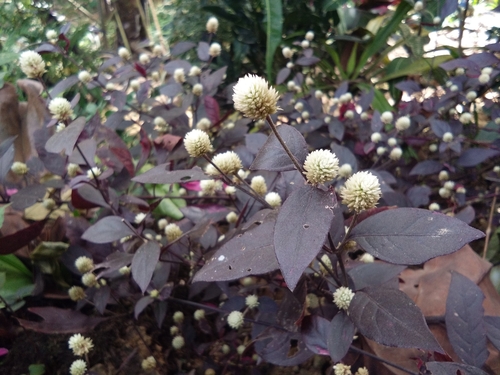
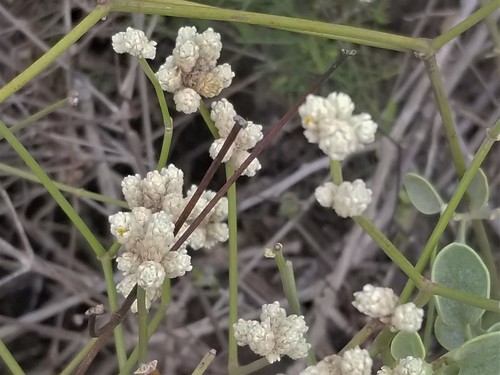
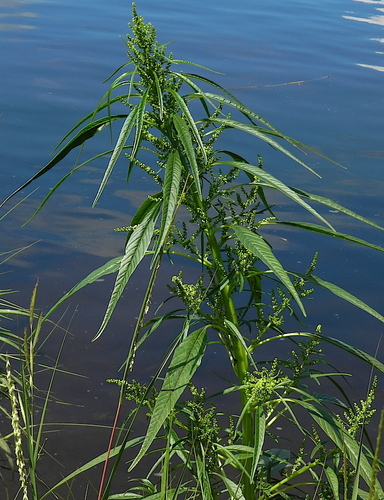
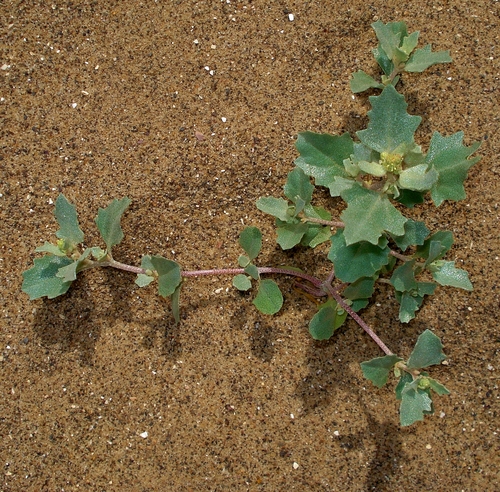
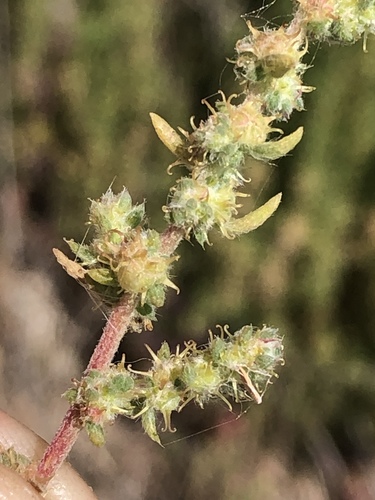
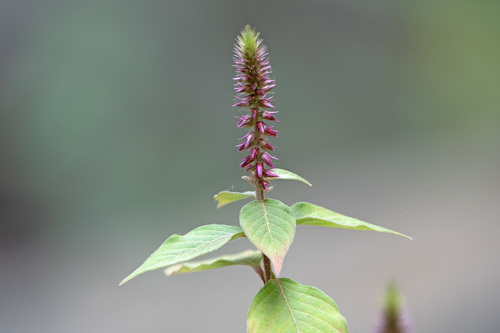
Achyranthes aspera L. is a wild perennial erect herb. Its stems are herbaceous but woody at the lower portion, erect, branched, cylindrical, solid, angular, hairy, and longitudinally striated, with prominent nodes and internodes; stems are green, but nodes are violet or pink. Leaves are both ramal and cauline, simple, exstipulate, opposite decussate, petiolate, ovate or obovate, with entire margins, acute or acuminate tips, covered entirely in hairs, and have unicostate reticulate venation. The inflorescence is a spike with reflexed flowers arranged on a long peduncle. Flowers are bracteate and bracteolate, with two bracteoles that are shorter than the perianth, dry, membranous, and persistent. Individual flowers are sessile, complete, hermaphrodite, actinomorphic, pentamerous, hypogynous, small, spinescent, and green. Bracts are ovate, persistent, and awned. The perianth consists of 5 tepals, which are polyphyllous, arranged in imbricate or quincuncial order, green, ovate to oblong, and persistent. The androecium is made up of 10 stamens: 5 are fertile, and 5 are scale-like, fimbriated sterile staminodes. Fertile stamens and staminodes alternate with one another; fertile stamens are antiphyllous and monadelphous, with filaments slightly fused at the base, and are dithecous, dorsifixed or versatile, and introrse. The gynoecium is bicarpellary, syncarpous, and superior, with a single locule, one ovule, and basal placentation; it has a single filiform style and a capitate stigma. The fruit is an oblong utricle. Seeds are endospermic with a curved embryo, 2 mm long, oblong, and black. Flowering and fruiting occur from September to April. According to the Samarāṅgaṇa Sūtradhāra, a Sanskrit treatise focused on Śilpaśāstra, the Hindu body of precepts about art and construction, the juice of this plant is a potent ingredient in wall plaster mixture. This species has been used in folk medicine, including 19th-century Australia. The 1889 book *The Useful Native Plants of Australia* records that this plant is found "in all the tropical and sub-tropical regions of the old world. The herb is administered in India in cases of dropsy. The seeds are given in hydrophobia, and in cases of snake-bites, as well as in ophthalmia and cutaneous diseases. The flowering spikes, rubbed with a little sugar, are made into pills, and given internally to people bitten by mad dogs. The leaves, taken fresh and reduced to a pulp, are considered a good remedy when applied externally to the bites of scorpions. The ashes of the plant yield a considerable quantity of potash, which is used in washing clothes. The flowering spike has the reputation in India (Oude) of being a safeguard against scorpions, which it is believed to paralyse. (Drury.)"