About Acanthus mollis L.
Scientific Name
Acanthus mollis L.
Description
Growth Form
Acanthus mollis is a leafy, clump-forming perennial herb with tuberous roots.
Leaf Characteristics
It produces a basal rosette of dark glossy green, lobed or divided, glabrous leaves. Each leaf is 50 cm (20 in) long and 30 cm (12 in) wide, growing from a petiole 20–30 cm (7.9–11.8 in) long.
Flower Spike
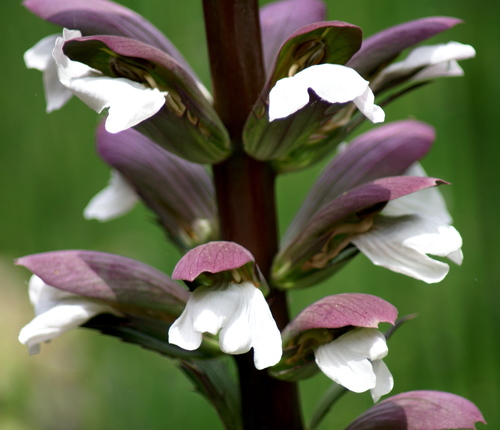
Flowers are borne on an erect spike up to 200 cm (79 in) tall that emerges from the leaf rosette.
Flower Structure
The purplish sepals function as the upper and lower lips of the flower structure: the upper lip is about 4 cm (1.6 in) long, and the lower lip is 3 cm (1.2 in) long. The actual petals are 4–4.5 cm (1.6–1.8 in) long, forming a tube with a ring of hairs at the point where stamens attach.
Flowering Period
Flowering occurs in summer.
Fruit and Seeds
The fruit is a sharply-pointed capsule about 2 cm (0.79 in) long, containing one or two brown seeds approximately 14 mm (0.55 in) long and 8 mm (0.31 in) wide.
Distribution and ecology
Native and Introduced Range
Although native to the eastern and central Mediterranean, Acanthus mollis has spread throughout much of western Europe, as well as parts of the Americas, Australia, Syria and New Zealand, where it is classified as an invasive species.
Pollination
This species is entomophilous, and is only pollinated by bees or bumblebees large enough to force their way between the upper and lower sepals to reach nectar at the base of the flower tube.
Use in horticulture
Propagation and Growth
These plants are usually propagated from tubers, and tend to form large, localized clumps that can survive for several decades, appearing statuesque when well grown.
Horticultural Drawbacks
However, its suitability as a garden plant is reduced by its aggressive spread—new plants grow readily from both seed and root fragments—and it is also susceptible to damage from slug and snail attacks.