About Acacia simsii A.Cunn. ex Benth.
General Description
Acacia simsii A.Cunn. ex Benth. is a smooth shrub that grows 1 to 4 metres tall.
Phyllode Shape and Size
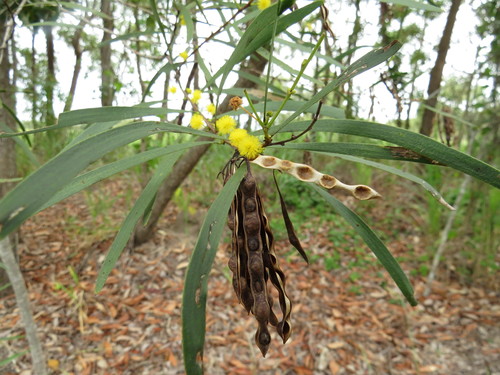
Its phyllodes are shaped linear to narrowly elliptic, and are straight or sometimes incurved, measuring 5–14 cm long and 2–7 mm wide.
Phyllode Texture and Nerves
The phyllodes have pointed tips, a leathery texture, 3 or 4 main longitudinal nerves, and a small number of minor longitudinal nerves between the main ones.
Phyllode Glands
A gland is located 0–2 mm above the pulvinus, and up to five additional glands are found along the adaxial margin.
Inflorescence Arrangement
Inflorescences typically grow as clusters of heads in leaf axils, borne on 5–12 mm long peduncles.
Flower Bracts
The bracts at the base of the flowers are persistent.
Flower Head Characteristics
The flower heads are globular, 3.5–4 mm in diameter, and hold 25 to 35 golden flowers.
Flower Structure
Each flower has five parts, with sepals that are either free or joined for up to two-thirds of their length.
Pod Features
The pods are leathery, smooth, linear, and flat but raised over the contained seeds, reaching up to 8 cm long and 4–7 mm wide.
Seed Shape and Color
The seeds are dull brown-black, arranged longitudinally, and shaped from almost circular to broadly elliptic.
Seed Size and Aril
They are 2.5 to 4 mm long, and have a clublike aril.
Habitat Preference
This species is most commonly found growing on gently undulating terrain, in sand and gravel within open eucalypt forest and woodland.
Special Habitat Occurrences
It sometimes occurs in closed heath, and may form closed scrub in disturbed areas.
Related Species Distinction
It is closely related to Acacia multisiliqua, which generally has shorter phyllodes, with the lowest gland typically positioned further from the pulvinus, a shorter peduncle, and larger seeds with a different shape.