About Acacia saligna (Labill.) H.L.Wendl.
Scientific name: Acacia saligna (Labill.) H.L.Wendl.
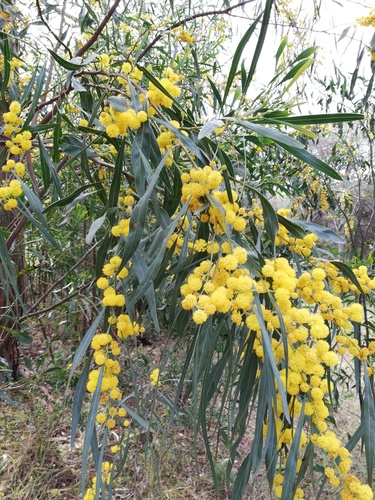
Description: Acacia saligna grows as a small, dense, spreading tree with a short trunk and a weeping growth habit, reaching up to 8 meters tall. Like many Acacia species, it has phyllodes instead of true leaves; individual phyllodes can grow up to 25 centimeters long. A nectary gland at the base of each phyllode secretes sugary fluid that attracts ants, which are thought to lower populations of leaf-eating insects. Bright yellow flowers emerge in late winter and early spring, arranged in groups of up to ten spherical flower heads. Its fruit is a legume, and its seeds are oblong and range from dark to black in color.
Also known as coojong, this species is a natural colonizer that typically grows in disturbed soil, such as along new roads. Its seeds are distributed by ants, which store the seeds in their nests to consume seed-stalks. Soil disturbance brings buried seeds to the surface and enables germination. Seeds germinate easily, and hundreds of seedlings can sometimes grow beneath a single parent tree. Young Acacia saligna are extremely vigorous, often growing over one meter per year.
Uses: Acacia saligna can grow across a wide range of soil conditions to form a woody shrub or tree, so it is used for many purposes. It has been utilized for tanning, revegetation, animal fodder, mine site rehabilitation, firewood, mulch, agroforestry, and as an ornamental decorative plant. It has been widely planted in semi-arid regions of Africa, South America, and the Middle East as windbreaks, and to stabilize sand dunes or control erosion.