About Acacia salicina Lindl.
Scientific name: Acacia salicina Lindl.
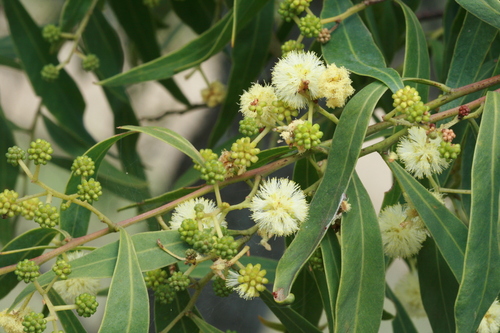
Description: Acacia salicina is an erect or spreading shrub or tree growing 3–10 metres tall, occasionally reaching up to 20 m, and it often suckers freely. It has finely fissured, brownish bark. Branchlets are pendent, glabrous, and angled or flattened toward their tips. The glabrous phyllodes are pendent, shaped narrowly elliptic to narrowly oblanceolate, and straight or slightly curved; they usually measure 5–16.5 cm long and 5–12 mm wide. Phylodes feature a prominent midvein, are penniveined, and end in a mucro at the apex. They have 2–5 small glands along the margin, and their pulvinus is 1–3 mm long. Usually 1–8 inflorescences grow in an axillary raceme with a 0.5–6 cm long axis; peduncles are 4–15 mm long and glabrous. The flower heads are globose, hold 15–30 flowers, measure 7–10 mm in diameter, and are pale yellow to white. The seed pods are straight or slightly curved, roughly flat, and range from straight-sided to irregularly constricted between seeds, measuring 3–12 cm long and 7–13 mm wide. They are woody and become slightly longitudinally wrinkled when dry. Seeds are longitudinal and glabrous. The funicle is expanded with 2–4 folds toward the seed, and is scarlet to orange in colour.
Uses Erosion management: Acacia salicina can be used to stabilize riverbanks and other areas. Fodder: The tree's foliage and seed pods are important livestock fodder during dry periods, as it tolerates drought very well. However, its foliage and pods have much lower digestibility for livestock than other fodders, which reduces their nutritional value. The 1889 publication *The Useful Native Plants of Australia* records that "The leaves are eaten by stock. This is another tree which is rapidly becoming scarce, owing to the partiality of stock to it." Food: The seeds of Acacia salicina are edible. Landscaping: A. salicina is excellent for landscaping in dry regions. Tannin: The bark has a high tannin content. Wood: The wood is very hard and is used to make fine furniture. Historically, it was used to manufacture axles for wagon wheels. A. salicina wood burns well and makes good fuel, with a calorific content of 18900kJ/kg per dry mass. Trees can produce seed and usable timber for woodworking as early as five years after planting. Other uses: Indigenous Australians have traditionally used the bark as a toxin for fishing. The leaves of A. salicina are thought to be psychoactive, as Indigenous Australians "burn its leaves and smoke the ash to obtain a state of inebriation."