About Acacia rupicola F.Muell. ex Benth.
Scientific Name
Acacia rupicola F.Muell. ex Benth.
Description
Growth Habit
This glabrous, diffuse, moderately resinous shrub usually grows 1 to 2.5 metres (3.3 to 8.2 ft) tall.
Branchlet Features
It has prominently ribbed branchlets with no stipules.
Phyllode Characteristics
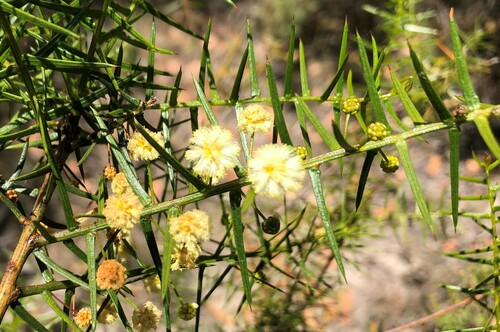
Its sessile, spreading green phyllodes are narrowly triangular to linear-triangular, measuring 5 to 25 mm (0.20 to 0.98 in) in length and 1.5 to 3 mm (0.059 to 0.118 in) in width, with a distinct prominent midrib.
Flowering Details
Flowering occurs primarily between August and January, with occasional sporadic flowering at other times of the year, and it produces yellow flowers.
Similar Species Distinction
It closely resembles Acacia ulicifolia (Prickly Moses) in appearance, but is easily distinguished by its characteristic sticky, resinous surface.
Distribution
Native Range
This species is endemic to Australia, with a native range spanning a large area from the Eyre Peninsula in South Australia in the west, eastward through Bordertown to the Grampians in Victoria.
Habitat Preferences
It grows in rocky coastal areas in sandy to loamy soils, most often as a component of open scrub or woodland plant communities.
Cultivation
Propagation Methods
Acacia rupicola can be propagated from seed or cuttings.
Recommended Planting Uses
This shrub is recommended for use as an understorey plant, suited for cultivation in second-line coastal positions, plains, or foot-slopes.
Growing Conditions
It grows well in dry full sun, shaded locations, and rocky areas, and is commonly planted in parks, reserves, highway verges, batters, and wide median strips.
Soil Requirements
It requires well-drained soil to thrive.
Ecological and Tolerance Traits
It attracts birds and insects, tolerates drought, and can withstand moderate frost.