About Acacia parvipinnula Tindale
Scientific name: Acacia parvipinnula Tindale
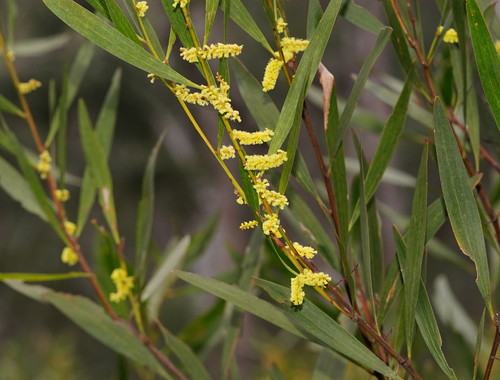
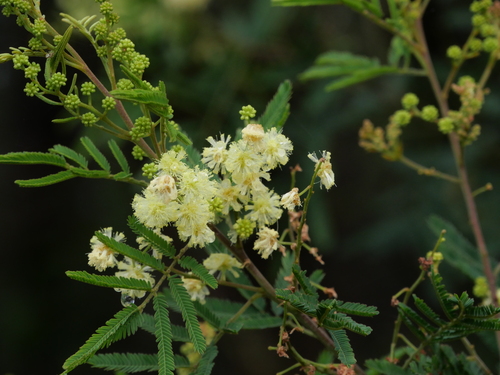
Description: This species grows as an erect shrub or tree, typically reaching 2 to 10 m (6 ft 7 in to 32 ft 10 in) in height. It has smooth silvery to bluish-grey bark, and angled to erect branchlets marked with low ridges; branchlets are often covered in a fine white powder and densely covered with minute hairs. Its hairy leaves measure 0.5 to 1.7 cm (0.20 to 0.67 in) in overall length, with a 1.5 to 8 cm (0.59 to 3.15 in) long rachis that bears 4 to 13 pairs of pinnae. The pinnae are 1 to 5 cm (0.39 to 1.97 in) long, and each holds 13 to 42 pairs of narrowly oblong pinnules, which are 2 to 4 mm (0.079 to 0.157 in) long and 0.5 to 1 mm (0.020 to 0.039 in) wide. Flowering occurs between April and January, producing simple inflorescences arranged in both axillary and terminal panicles and racemes, borne on stalks 2 to 5 mm (0.079 to 0.197 in) long. The spherical flower-heads are 4 to 6 mm (0.16 to 0.24 in) in diameter and contain 14 to 20 pale yellow flowers. After flowering, straight to curved leathery seed pods form that are slightly constricted between seeds, usually with deeper irregular constrictions. The sparsely hairy pods are around 2 to 17 cm (0.79 to 6.69 in) long and 5 to 8.5 mm (0.20 to 0.33 in) wide.
Distribution: Acacia parvipinnula has a limited distribution in coastal areas of central New South Wales, ranging from around Singleton to around the Shoalhaven River. It occurs in a variety of habitats across many different soil types, as a component of dry sclerophyll forest or woodland communities.