About Acacia nervosa DC.
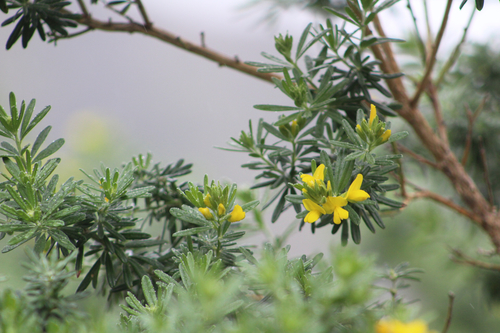
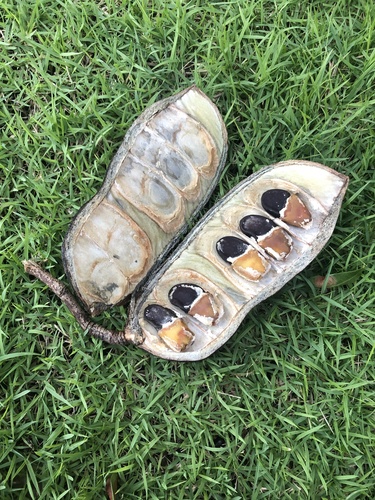
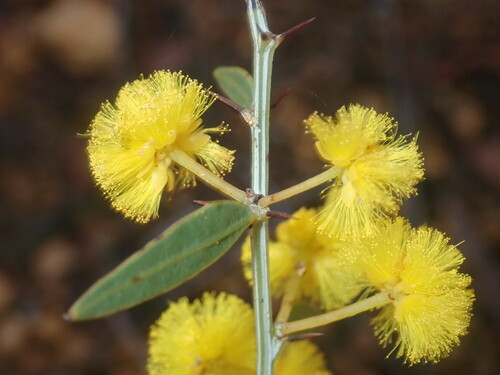
Acacia nervosa DC. is an erect or sprawling shrub that typically grows 0.2 to 0.5 metres (0.7 to 1.6 ft) tall. It can be single-stemmed or multi-stemmed, sprouting from a woody rootstock. Its branchlets are pruinose and prominently ribbed. The pungent, greyish green phyllodes are slightly inequilateral, with a shape ranging from narrowly elliptic to straight or shallowly incurved. Phyllodes measure 1 to 5 centimetres (0.4 to 2.0 in) in length and 4 to 12 millimetres (0.157 to 0.472 in) in width. Flowering occurs from June to October, when the shrub produces bright yellow flowers. Inflorescences have two to four heads; the prolific, showy globular heads each hold 7 to 12 loosely arranged bright golden flowers. After flowering, woody dark brown seed pods form. These pods are twisted and narrowly oblong, reaching up to 5 cm (2.0 in) long and 8 to 9 mm (0.315 to 0.354 in) wide, with thick margins. Inside the pods, seeds are oblong to circular, shiny, greyish brown, and 3 to 4 mm (0.118 to 0.157 in) long. This species is native to the Great Southern, South West and Peel regions of Western Australia. It grows in gravelly clay or sandy lateritic soils. Its main distribution range extends north to Mogumber, south along the coast to Cape Naturaliste, and east along the coast to Albany, with separate outlying populations located in Tammin, Katanning and Mount Barker. It is commonly found near watercourses, or as a member of Eucalyptus woodland or forest communities. This shrub is available commercially as seed or as seedlings. It is a hardy, dieback-resistant plant. To grow from seed, seeds must be pretreated with hot water before planting, and germination takes approximately four weeks.