About Acacia myrtifolia (Sm.) Willd.
Scientific name: Acacia myrtifolia (Sm.) Willd.
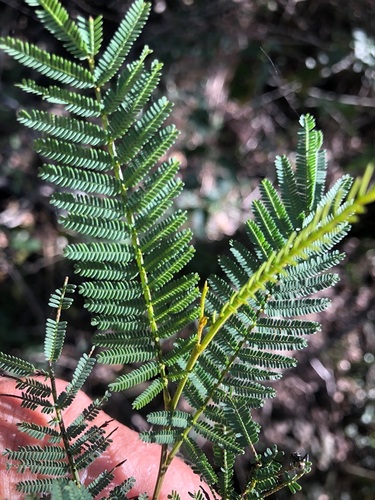
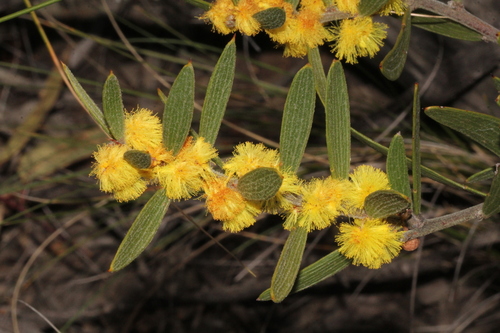
Description Acacia myrtifolia is a small, bushy, glabrous shrub that typically reaches 0.3–3 m (0.98–9.84 ft) in height and 2–3 m (6.6–9.8 ft) in width. It has smooth grey bark, and its distinctive red branches angle upward and bear prominent ridges. Its green, slightly curved phyllodes have an elliptic to narrowly elliptic, or oblanceolate shape; each phyllode measures 2–9 cm (1-3½ in) long and 0.5–3 cm wide.
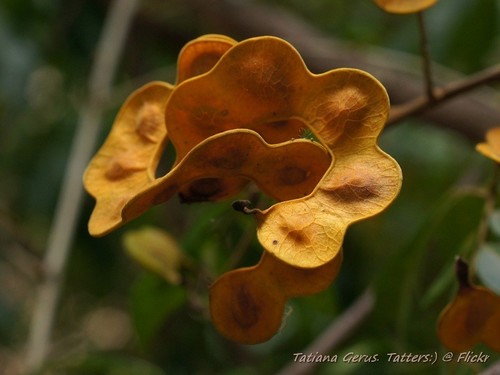
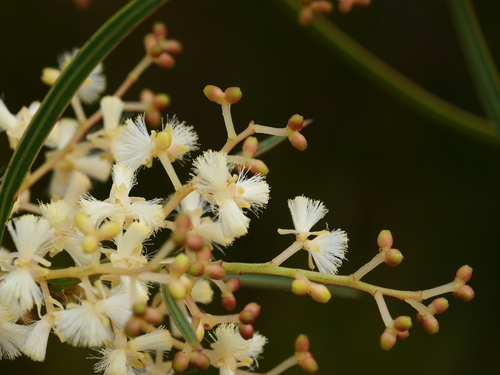
Its flowers are creamy white or pale yellow, and bloom in winter and spring. The glabrous inflorescence forms globose heads 6 to 13 mm (0.24 to 0.51 in) in diameter. After flowering, the plant produces curved seed pods 4–7 cm (1.5–3 in) long. These pale pods have prominent margins, and are thinly woody to firm and brittle when dry. Shiny brown narrowly oblong seeds, 3.5 to 4.5 mm (0.14 to 0.18 in) long, are arranged longitudinally inside each pod.
Distribution This shrub occurs along the south coast of Western Australia, extending inland into the South West, Wheatbelt, Great Southern and Goldfields-Esperance regions, ranging from Albany in the south to Kondinin in the north, and from Augusta in the west to Cape Arid in the east. It grows successfully in a range of habitats in gravelly or sandy soils.
It is also found along coastal areas of South Australia east of the Eyre Peninsula, continuing along coastal regions of Victoria and New South Wales, and extending north into Queensland as far as Gladstone, as well as in coastal areas of Tasmania. Its most common habitats are open forest, mixed woodlands, scrub or heath, usually in coastal or near-coastal locations. The distribution of this shrub closely matches the combined distribution ranges of Acacia subcaerulea and Acacia suaveolens.
Cultivation Acacia myrtifolia was one of the first Australian native plants to be cultivated in Europe. It has also been cultivated in Australia, but it is not widely used in gardens, because many other Acacia species have more colourful flowers.
It prefers well-drained soils and full sun, and tolerates moderate frosts. Light pruning after flowering encourages a bushy growth habit. When propagated from seed, pre-treatment by soaking in boiling water or scarification is required; propagation from cuttings is also successful. This fast-growing shrub is suitable for low-maintenance gardens, roadside verges, and large median strips, where it can be used as a windbreak, natural barrier, or for erosion control.