About Acacia loroloba Tindale
Species Identity and Size
Acacia loroloba Tindale is a tree that typically grows to a height of 9 metres (30 ft).
Bark Characteristics
Its bark is red or green and smooth when young, turning grey or brown as it ages.
Branchlet Characteristics
The branchlets are dark brown, black to dark blue, glabrous, and are prominently ridged when immature.
New Foliage Features
The tips of new young foliage are pale yellow or golden, and covered in velvety hairs.
Leaf Stalk Characteristics
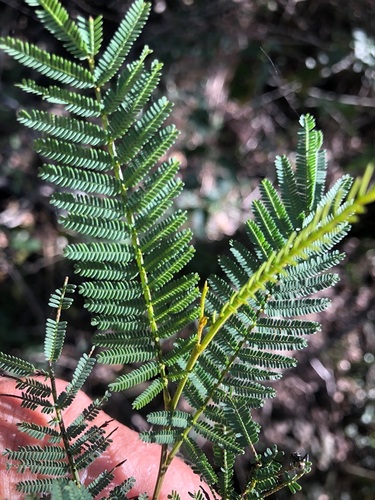
The dark green, leathery (coriaceous) leaves are borne on a stalk 0.5 to 1.6 cm (0.20 to 0.63 in) long.
Leaf Rachis and Pinnae
The leaf rachis measures 3.5 to 8 cm (1.4 to 3.1 in) in length, and holds 10 to 18 pairs of pinnae that are 1 to 3.5 cm (0.39 to 1.38 in) long.
Pinnule Characteristics
Each pinna is made up of 14 to 49 pairs of pinnules, which are narrowly oblong in shape, 1 to 3 mm (0.039 to 0.118 in) long, and 0.5 to 0.8 mm (0.020 to 0.031 in) wide.
Blooming Period
It mostly blooms between December and March, but will sometimes bloom between July and August, usually after rain.
Inflorescence Features
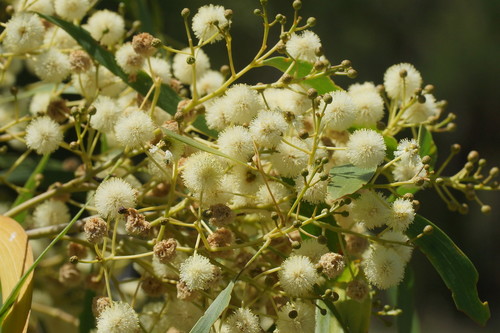
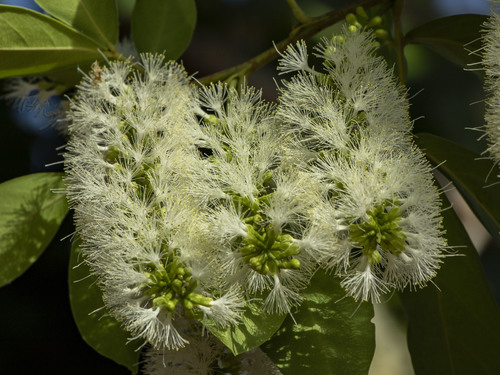
It produces simple inflorescences that are most often found in axillary racemes.
Flower Head Characteristics
The spherical flower-heads contain 19 to 23 pale yellow flowers.
Seed Pod Development Timing
After flowering, which occurs from around August to November, leathery brown to black seed pods form.
Seed Pod Dimensions
The seed pods have more or less straight sides, and are 6 to 14 cm (2.4 to 5.5 in) long and 6 to 9 mm (0.24 to 0.35 in) wide.
Endemic Range
This species is endemic to south eastern Queensland, Australia.
Distribution Extent
It is most often found in the north eastern Darling Downs region, ranging from around Haden and Jandowae in the west to Toowoomba in the east, and as far north as Durong.
Habitat and Ecology
It grows on undulating terrain, alluvial flats and fertile plains, in clay or sandy loam soils, and is usually a component of open forest or woodland plant communities.