About Acacia glaucoptera Benth.
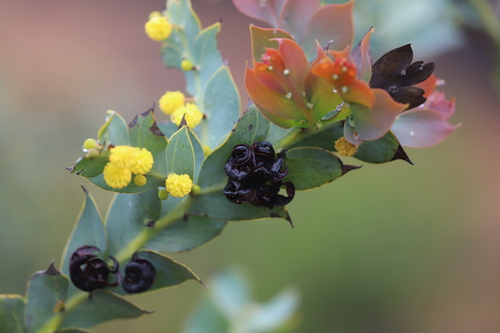
Acacia glaucoptera Benth. is commonly known as clay wattle. It is a prostrate, semi-prostrate, sprawling, or erect shrub that typically reaches 0.3 to 1.5 metres (1 foot 0 inch to 4 feet 11 inches) in height, and often has somewhat gangling branches. Its branchlets are glabrous, and are either straight or slightly winding. The phyllodes of this plant are continuous with the branchlets, forming wings along alternate sides. Each wing extends down to meet the wing below it, and is usually 25 to 70 millimetres (0.98 to 2.76 inches) long and 6 to 20 millimetres (0.24 to 0.79 inches) wide; the free portion of the phyllode is usually 10 to 40 millimetres (0.39 to 1.57 inches) long. Its flowers grow in spherical heads located in leaf axils, attached to a 3 to 18 millimetre (0.12 to 0.71 inch) long peduncle. The flower heads are 5 to 6 millimetres (0.20 to 0.24 inches) in diameter, and hold between 30 and 80 golden yellow flowers. Flowering occurs mainly from August to December, with the main flowering flush falling between August and October. The seed pods of this species are irregularly coiled and twisted, growing up to 20 millimetres (0.79 inches) long and 2 to 3 millimetres (0.079 to 0.118 inches) wide. They have a thin crusty texture, are black in colour, and are glabrous. The seeds are roughly oblong in shape, measuring 2.5 to 3.5 millimetres (0.098 to 0.138 inches) long, with a conical aril at one end. Clay wattle grows in clay and gravelly soils in woodland, shrubland, and mallee habitats. Its range extends from near Narrogin, south to near Manypeaks, and east to Israelite Bay, across the Avon Wheatbelt, Esperance Plains, Jarrah Forest, and Mallee bioregions of south-western Western Australia. In horticulture, this species is often grown for its distinctive wing-like phyllodes. It requires good drainage, and occasional pruning to remove dead wood. It can tolerate temperatures as low as −7 °C.