About Acacia genistifolia Link
Scientific name: Acacia genistifolia Link
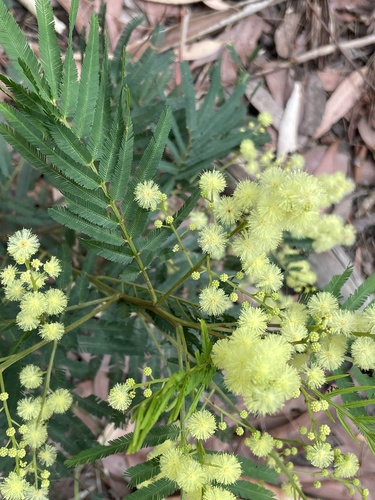
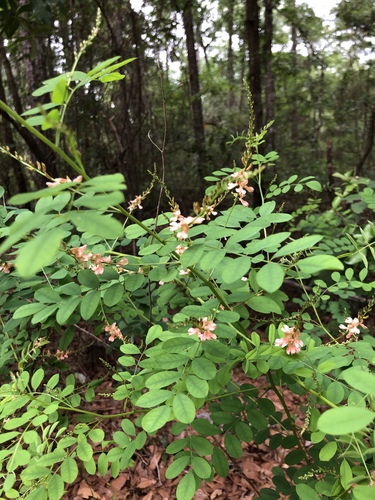
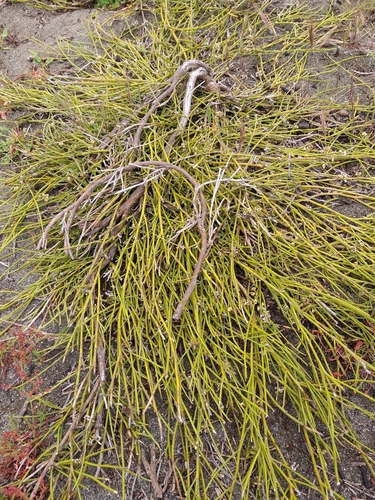
Description: Acacia genistifolia is an open, erect, straggly, or spreading shrub that typically grows to 0.6–3 m (2 ft 0 in – 9 ft 10 in) in height, and has ribbed branchlets. Its phyllodes are sessile, straight to slightly curved, flat, and sharply pointed, measuring 10–40 mm (0.39–1.57 in) long and 1–3 mm (0.039–0.118 in) wide, with a gland located 2–4 mm (0.079–0.157 in) above the phyllode base. Stipules, approximately 1 mm (0.039 in) long, form at the base of the phyllodes, but are sometimes shed early. Flowers are typically arranged in two to four spherical heads in leaf axils, borne on peduncles 10–20 mm (0.39–0.79 in) long; each flower head contains 12 to 25 cream-coloured to lemon yellow flowers. Flowering usually occurs from July to October. The seed pods are linear, ranging from curved to more or less straight, 40–110 mm (1.6–4.3 in) long and 4–7 mm (0.16–0.28 in) wide; they are thinly leathery, and their surface is raised over the seeds. The seeds themselves are 3.5–5.5 mm (0.14–0.22 in) long, with an aril at one end.
Distribution and habitat: This species, commonly called spreading wattle, grows in a range of soil types in sclerophyll forest or heathland. Its distribution spans south-eastern Australia: in New South Wales, it occurs south from Bathurst and west to Grenfell and Griffith; it is widespread across Victoria, apart from the mallee region and higher elevations of the Great Dividing Range; it is abundant in northern and eastern Tasmania, including Flinders Island and Bruny Island; and in South Australia, it is only found north of Mintaro.