About Acacia flavescens A.Cunn. ex Benth.
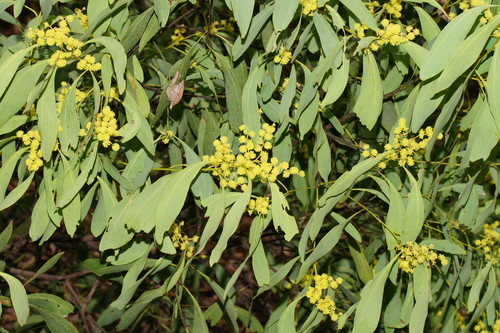
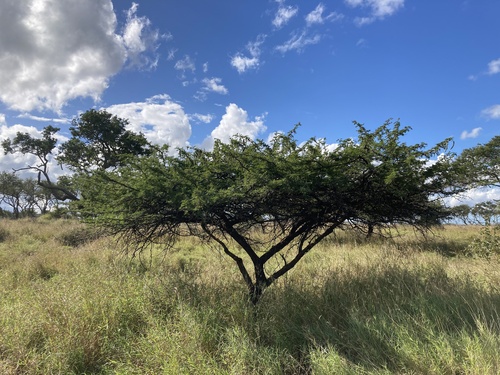
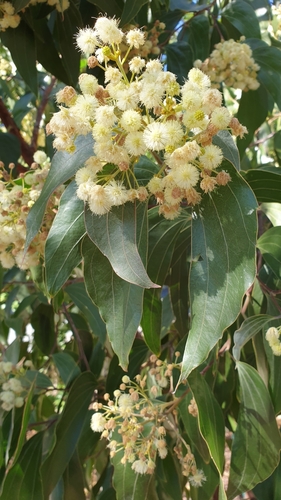
### Description Acacia flavescens A.Cunn. ex Benth. is a tree that typically reaches a height of 4–20 m (13–66 ft). It has rough, furrowed, somewhat shaggy bark. Its branchlets are covered with star-shaped hairs, while new shoots bear golden hairs. The phyllodes are narrowly elliptic to lance-shaped, measuring 90–300 mm (3.5–11.8 in) long and 20–70 mm (0.79–2.76 in) wide. They are more or less glabrous and have three prominent main veins.
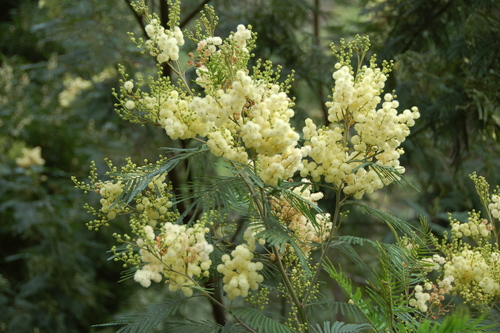
Flowers are arranged in spherical heads, held in racemes 20–100 mm (0.79–3.94 in) long that grow in leaf axils, or in panicles at the ends of branchlets, on peduncles 6–28 mm (0.24–1.10 in) long. Each flower head is 4.5–6 mm (0.18–0.24 in) in diameter and contains 30 to 60 cream-coloured flowers.
The seed pods are flat, glabrous, thinly leathery, and grow up to 120 mm (4.7 in) long and 15–25 mm (0.59–0.98 in) wide. The seeds are elliptic, 6–7 mm (0.24–0.28 in) long, dull black, and have an aril.
### Distribution and habitat This wattle species is widespread, occurring mainly in near-coastal areas of eastern Queensland, Australia, from Cape York Peninsula south to near Brisbane. It grows in sand in eucalypt forest and woodland, and sometimes along the margins of monsoon forest and rainforest, at altitudes from sea level to 1,000 metres (3,281 ft).
### Cultivation and uses This species is sold commercially as seed. Seeds require pre-treatment by scarification or soaking in hot water before planting. The tree grows well in sunny locations across a wide range of soils, including poor soils. It is fast-growing and can produce root suckers, which means it may become a problematic weed. It forms a symbiotic relationship with nitrogen-fixing bacteria that grow on its root nodules.
The wood of Acacia flavescens can be used as fuel, and the tree is grown for soil stabilization and erosion control. Its bark contains 10 to 26% tannin, is an astringent, and can be used externally to treat wounds, or internally to treat diarrhoea and dysentery.