About Acacia falciformis DC.
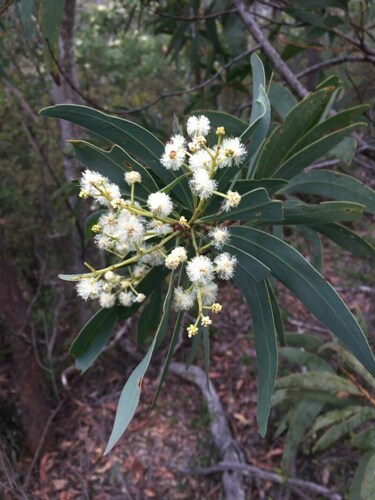
Acacia falciformis DC. is an erect or spreading shrub or tree that typically grows to a height of 2–10 m (6 ft 7 in – 32 ft 10 in), and may sometimes grow taller. It has finely or deeply fissured, grey-black bark. Its branchlets are glabrous: they are angled when young, but quickly become terete. The phyllodes are more or less pendulous, usually sickle-shaped, 100–220 mm (3.9–8.7 in) long, 15–30 mm (0.59–1.18 in) wide, grey-green to glaucous, and glabrous. There is a prominent midrib on each phyllode, and a gland located 5–30 mm (0.20–1.18 in) above the base of the phyllode. Flowers are arranged in five to eighteen spherical heads held in racemes in leaf axils, and sometimes in panicles at the ends of branches, on peduncles 4–10 mm (0.16–0.39 in) long. Each spherical head contains 20 to 30 flowers, which are pale yellow to cream-coloured, or occasionally bright yellow. Flowering occurs from July to October, with the peak of flowering falling in August and September. The seed pods are 50–130 mm (2.0–5.1 in) long and 5.5–9 mm (0.22–0.35 in) wide, flat, and more or less straight or slightly curved. The pods are thinly leathery, and are slightly or more deeply constricted between individual seeds. The seeds are oblong to more or less elliptic, 5.5–7 mm (0.22–0.28 in) long, slightly shiny black, and have a club-shaped aril. This species, commonly called mountain hickory, is common on the tablelands and slopes of the Great Dividing Range, mostly at altitudes between 800 and 1,200 m (2,600 and 3,900 ft). Its range extends from Traralgon in Victoria, through New South Wales and the Australian Capital Territory, to the Atherton Tableland in Queensland, and it is uncommon north of Warwick. It grows in clay loam in forest or woodland, and is often found in moist gullies or on exposed rocky sites.