About Acacia falcata Willd.
Scientific Name
Acacia falcata Willd.
Description
Growth Form
Acacia falcata is an erect, slender shrub or tree that typically reaches a height of 2–5 m (6 ft 7 in – 16 ft 5 in).
Bark and Branchlets
It has smooth or finely fissured bark, and red-brown, glabrous branchlets that are often covered with a whitish bloom.
Phyllode Characteristics
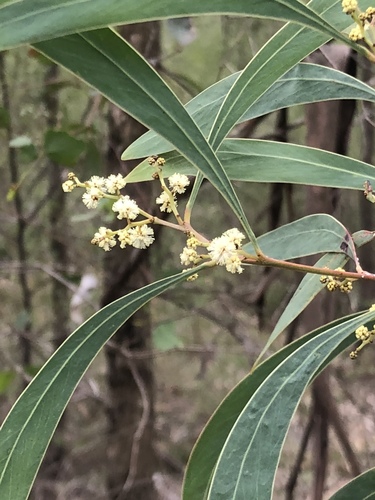
Its phyllodes are sickle-shaped, broadest above the middle and narrowed at the base; they measure 70–190 mm (2.8–7.5 in) long and 10–40 mm (0.39–1.57 in) wide, are thin, and range in colour from greyish green to glaucous, with an excentric midrib.
Inflorescence Structure
Flowers are arranged in spherical heads held in racemes that are usually 20–60 mm (0.79–2.36 in) long, on a peduncle 3–4 mm (0.12–0.16 in) long.
Flower Details
Each head contains 15 to 20 creamy white flowers. Flowering occurs from April to August.
Seed Pod Features
The seed pods are linear, straight to slightly curved, up to 120 mm (4.7 in) long and 5–8 mm (0.20–0.31 in) wide; they are firmly leathery, blackish, glabrous, and often covered with a thin powdery coating.
Seed Characteristics
The seeds are oblong to egg-shaped, 3.5–4.5 mm (0.14–0.18 in) long, black and somewhat shiny, with a club-shaped aril.
Distribution and habitat
Native Range
This wattle, also called Burra, is native to coastal regions and the eastern slopes of the Great Dividing Range, ranging from Bundaberg, Herberton and Ingham in Queensland, south through eastern New South Wales to Narooma.
Habitat Preferences
It is common in the understorey of Eucalyptus communities, often growing in shallow, stony soil. It grows predominantly on shale soils in open forest, and is associated with tree species including Eucalyptus paniculata, E. longifolia and E. tereticornis.
Introduced Range
This species has been introduced to Java, Indonesia.
Ecology
Lifespan and Fire Response
In the wild, individual plants live for 5 to 20 years, and are killed by bushfire.
Seed Dynamics
Seeds are released in December, dispersed by wind, and stored in the soil. It remains unclear how closely germination is related to bushfire, and seeds can germinate in disturbed areas.
Faunal Associations
Acacia falcata is a host plant for the imperial hairstreak butterfly (Jalmenus evagoras). One field study recovered 98 species of Hemiptera (true bugs) from A. falcata across its native range.
Use in horticulture
Cultivation Adaptability
Acacia falcata adapts to a wide range of soils in cultivation, and is valued for its attractive foliage.
Propagation Method
It is propagated by seed, which requires pretreatment with boiling water to germinate.
Growing Requirements and Applications
It grows easily in a sunny position with good drainage, and is used for revegetation projects.
Indigenous and other uses
Traditional Medicinal Use
Indigenous Australian people use the bark of this species to make a liniment for treating skin ailments.
Erosion Control and Industrial Use
A. falcata is excellent for stabilizing barren sand. Its bark is important to the tanning industry.
Historical Naming and Uses
The 1889 book The Useful Native Plants of Australia records that common names for this species include 'hickory' and 'sally', and that Indigenous Australians from the Cumberland and Camden areas of New South Wales referred to it as Weetjellan. The book also notes that "This bark, which contains much tannin, was used by the Aboriginals of the counties of Cumberland and Camden to stupefy fish, and to make embrocations for the cure of cutaneous diseases."