About Acacia drummondii Lindl.
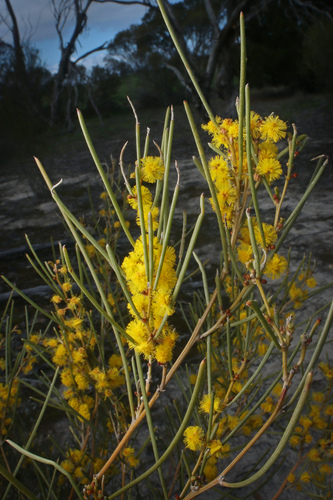
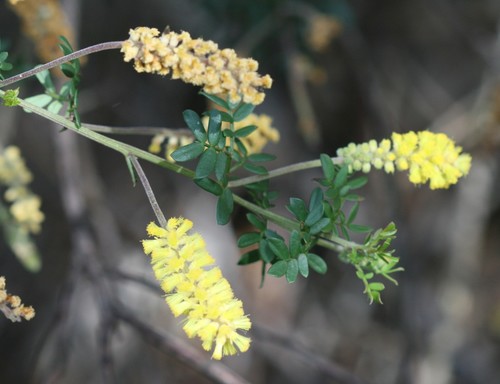
Acacia drummondii, commonly known as Drummond's wattle, is a shrub that typically grows to a height of 0.3 to 2 metres (1 foot 0 inch to 6 feet 7 inches). Its leaves are bipinnate, growing on a petiole 0.5 to 5 millimetres (0.020 to 0.197 inches) long, with up to four pairs of pinnae. The lower pinnae are 2 to 10 millimetres (0.079 to 0.394 inches) long, while pinnae near the end of the leaf are 4 to 20 millimetres (0.16 to 0.79 inches) long. Each pinna has two or three pinnules on its lower section, and two to seven pinnules near its end. The leaves range in colour from mid-green to slightly bluish green, and may be smooth or densely hairy. The flowers are pale to golden yellow, and are borne as single spikes 10 to 40 millimetres (0.39 to 1.57 inches) long in leaf axils, on a peduncle 10 to 30 millimetres (0.39 to 1.18 inches) long. Flowering occurs between June and October. After flowering, this species produces narrowly oblong, rigid pods that are dark or brownish-grey. The pods measure 15 to 50 millimetres (0.59 to 1.97 inches) long and 3.5 to 8 millimetres (0.14 to 0.31 inches) wide, and contain elliptic to oblong seeds 2 to 3.5 millimetres (0.079 to 0.138 inches) wide. Drummond's wattle is distributed in south-western Western Australia, ranging from near Mount Lesueur south to Albany, and also grows within Fitzgerald River National Park. It can be found around granite outcrops, in gullies, low-lying areas, and on hillsides, growing in sandy and gravelly soils across the Avon Wheatbelt, Esperance Plains, Geraldton Sandplains, Jarrah Forest, Mallee, and Swan Coastal Plain bioregions. Four subspecies have distinct ranges and habitat preferences: subspecies affinis occurs near New Norcia and south to Bullsbrook; subspecies candolleana has a sporadic distribution from near New Norcia south to Collie, with an isolated disjunct population in Fitzgerald River National Park; subspecies drummondii occurs from Moora to Boyup Brook in Eucalyptus wandoo woodland, and near Mount Lesueur in heath; subspecies elegans grows in loam or sand in winter-wet locations within forest and woodland in the Stirling Range-Albany area.