About Acacia cyclops A.Cunn. ex G.Don
Scientific name: Acacia cyclops A.Cunn. ex G.Don
Description: Acacia cyclops is a shrub or small tree that typically reaches 1–6 m (3 ft 3 in – 19 ft 8 in) in height, and has glabrous branchlets. Its phyllodes are ascending, and shaped from narrowly oblong to elliptic or egg-shaped with the narrower end at the base. Most phyllodes are 40–95 mm (1.6–3.7 in) long and 6–15 mm (0.24–0.59 in) wide, leathery, glabrous, and marked with three or four main veins.
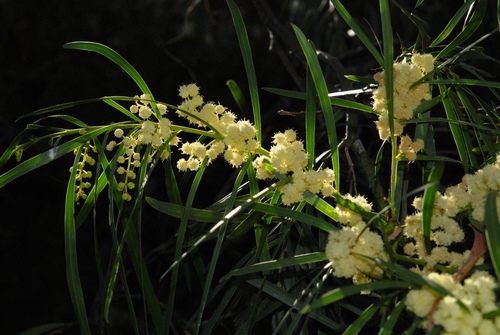
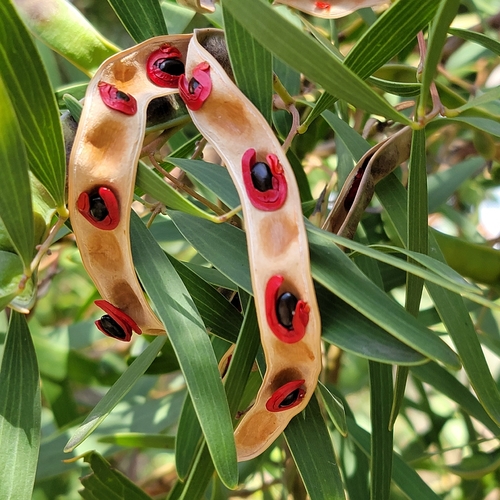
Flowers are borne in groups of two spherical heads in axils, on 4–12 mm (0.16–0.47 in) long peduncles. Each head is 5–7 mm (0.20–0.28 in) in diameter, and typically holds 60 to 75 golden yellow flowers. Flowering occurs from September to May. After flowering, it produces linear pods that grow up to 150 mm (5.9 in) long and 7–16 mm (0.28–0.63 in) wide; the pods are thickly leathery and glabrous. The seeds are elliptic, 5–7 mm (0.20–0.28 in) long, glossy dark brown to black, with an orange to scarlet attachment that encircles the whole seed.
Distribution and habitat: This coastal wattle has a widespread, apparently discontinuous range in coastal and near-coastal areas: it occurs mainly between Denmark and Israelite Bay in Western Australia, and from Leemann to Yorketown and the Yorke Peninsula in South Australia. It grows in coastal heath or scrubland, on coastal sand dunes and limestone.
Acacia cyclops has invaded similar habitats in other areas within Australia, mostly semi-arid regions of inland south-eastern South Australia, where it is considered a problematic species. It is also found along roadsides and waterways in parts of South Africa, and in wetland habitats and riparian communities in parts of California. It has been introduced to the Azores, California, the Canary Islands, the Cape Provinces, Cyprus, Ethiopia, Morocco, Namibia, the Northern Provinces, Palestine, Portugal, Sicily, Spain, and Saint Helena.
In South Africa, it is counted among the most widespread alien invasive species, and it is especially problematic in coastal and lowland areas of the Cape Provinces. Its roots are susceptible to attack by various species of Ganoderma fungi. The species was introduced to South Africa in the 1830s for dune stabilization; by 1975, it occupied around 300,000 ha (740,000 acres) of coastal lowlands and sandy inland river valleys, where it forms dense thickets. The introduction of the gall-forming cecidomyiid Dasineura dielsi as a biological control agent has only had limited success in controlling this species in introduced regions.
Uses: Indigenous Australians grind the seeds of this species into flour to make damper; the seeds are a good source of carbohydrates, fats, and protein. Green seed pods are crushed to make an insect repellent and sunscreen, which is also used to treat eczema. Crushed pods mixed with water can be used to make a soap solution, and green pods can be used directly as a natural soap for washing. Edible gum exuded from the trunk can be used as chewing gum, or to make glue. The wood is used to craft a variety of tools, and rotten wood of this species is a good source of witchetty grubs. This red-eyed wattle can also be used to stabilize coastal sands, the purpose for which it was introduced into Africa.