About Acacia cultriformis A.Cunn. ex G.Don
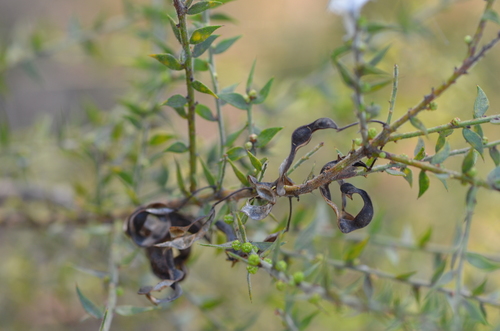
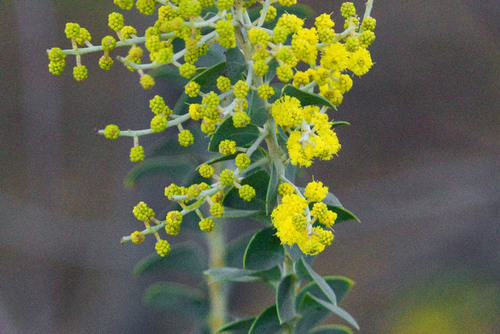
Acacia cultriformis A.Cunn. ex G.Don is a woody shrub with an upright or spreading growth habit, reaching up to 4 m (13 ft) in height. Its branchlets may be bare and smooth, or covered with a white bloom. Its phyllodes are fairly crowded, leathery, and green-grey, with an asymmetrical shape measuring 10–30 mm (0.39–1.18 in) long and 5–15 mm (0.20–0.59 in) wide. One leaf margin is angled, giving the phyllode an overall triangular shape, with a quite prominent gland located at the phyllode’s widest point. Flowering occurs from August to November, and can be prolific on the upper parts of the plant. Flowers grow in spherical or short cylindrical heads arranged in racemes that are 10–50 mm (0.39–1.97 in) long, sometimes reaching up to 200 mm (7.9 in) long. The racemes grow in leaf axils, on peduncles 2.5–5 mm (0.098–0.197 in) long. Each flower head holds 13 to 40 bright golden yellow flowers. After flowering, the plant produces narrowly oblong seed pods that are straight or slightly curved, and more or less flat with a raised contour over each seed. The pods grow up to 90 mm (3.5 in) long and 5–8 mm (0.20–0.31 in) wide, with a texture ranging from firmly papery to thinly leathery. The seeds themselves are 3.5–4.5 mm (0.14–0.18 in) long, black, and dull to slightly shiny, with a club-shaped aril. The related species Acacia semilunata looks very similar, but differs in having hairy branchlets and narrower seed pods. Acacia pravissima also has a similar appearance, but can be distinguished by a secondary longitudinal vein on its phyllodes. Acacia cultriformis is found on the western slopes of the Great Dividing Range in central New South Wales and southern Queensland. It occurs in discontinuous populations from north of Wagga Wagga and Narrandera, extending west of the Denman-Singleton area, and as far north as Stanthorpe and Inglewood in south-eastern Queensland. It grows in clay-loam or sandstone soils in Eucalyptus woodland, most often on rocky ridges. Thanks to its bright flowers and attractive foliage, Acacia cultriformis is one of the most popular wattles used in cultivation. It adapts well to garden settings, growing in a wide range of soils and tolerating frosts. It can grow in full sun or part shade, is drought tolerant, and can be planted to control soil erosion. Acacia 'Cascade' (registration number ACC154) is a prostrate cultivated form that spreads to a diameter of 2 m (7 ft). It was registered on 18 November 1982, after being propagated by Bill Molyneux at his nursery in Montrose, Victoria from a selected seedling. It works well as an attractive cascading plant for rockeries. A. cultriformis is also used as a cut flower. Its flowers are edible, and are used as an ingredient in some fritters. A yellow dye can be extracted from its flowers, and a green dye can be extracted from its seed pods.