About Acacia crassicarpa A.Cunn. ex Benth.
Taxonomic Naming
Acacia crassicarpa A.Cunn. ex Benth. is a tree that typically reaches 6–25 meters (20–82 feet) in height.
Tree Height
It has bark that is heavily fissured with numerous chinks, cracks, and crevices.
Bark Characteristics
Its branchlets are hairless (glabrous) and slightly angular near their tips.
Branchlet Features
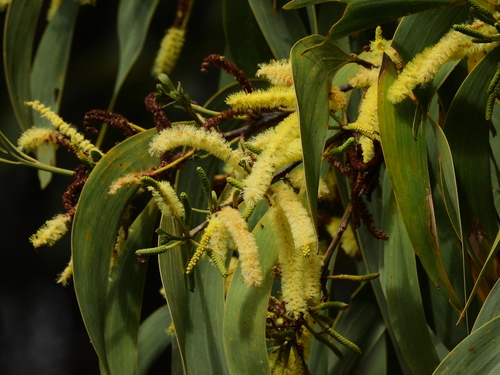
The species has leathery or thinly leathery phyllodes, shaped lanceolate to sickle-shaped, that measure 80–270 mm (3.1–10.6 in) in length and 10–45 mm (0.39–1.77 in) in width.
Phyllode Morphology
Its phyllodes have many parallel veins, with three veins that are more prominent than the others.
Phyllode Venation
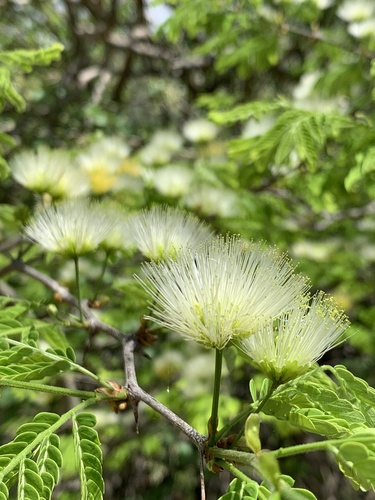
Pale yellow to light golden yellow flowers are produced in spikes 30–70 mm (1.2–2.8 in) long.
Flower Structure
Flowering takes place between May and September.
Flowering Period
The seed pods are flat, oblong to narrowly oblong, 40–120 mm (1.6–4.7 in) long and 20–45 mm (0.79–1.77 in) wide when including the wing.
Pod Dimensions
The pods are more or less straight, and sometimes become spirally twisted.
Pod Shape
The seeds are oblong to egg-shaped, black, 5–6 mm (0.20–0.24 in) long, with an aril 5–20 mm (0.20–0.79 in) long.
Seed Characteristics
This tree, commonly called thick-podded salwood, grows in woodlands and open forest on sandy or rocky soils.
Common Name & Habitat
In Australia, it is found in tropical Queensland, from the Torres Strait islands south as far as Townsville, with isolated disjunct populations on Whitsunday Island and near Mackay.
Australian Distribution
It also occurs in Irian Jaya and Papua New Guinea.