About Acacia continua Benth.
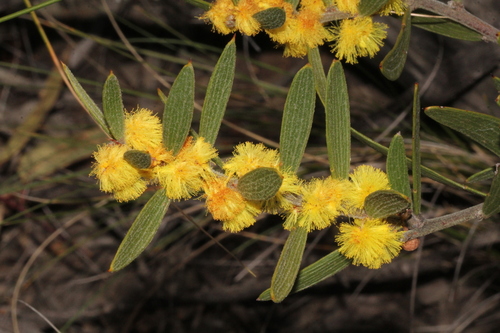
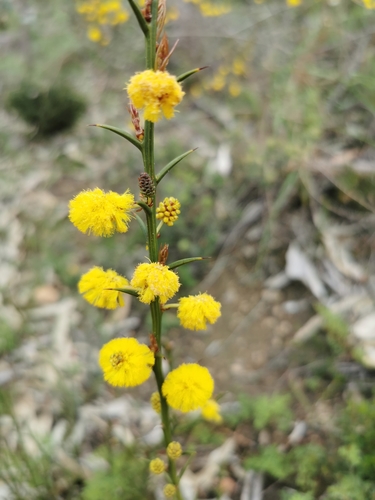
Acacia continua Benth. is an openly-branched, rigid shrub that typically grows up to 2 metres (6 feet 7 inches) high and 0.7 metres (2 feet 4 inches) wide, with ribbed, glabrous branchlets. Its phyllodes are continuous with the branchlets, straight or with downturned ends, 20–40 mm (0.79–1.57 in) long, 1.5–2 mm (0.059–0.079 in) in diameter, and end in a sharp point. Flowers are borne as one or two spherical heads in leaf axils, on a 2–6 mm (0.079–0.236 in) long peduncle, with prominent dark brown bracts at the peduncle base. Each flower head is 6–10 mm (0.24–0.39 in) in diameter and holds around 30 golden yellow flowers. Flowering occurs between July and October. After flowering, the species produces linear pods that are curved to once-coiled, constricted between seeds and raised over each seed. The pods are up to 80 mm (3.1 in) long and 3–4 mm (0.12–0.16 in) wide, with a leathery, glabrous texture. The seeds are elliptic, dull brown, 3–8 mm (0.12–0.31 in) long, and have a club-shaped aril. In New South Wales, Acacia continua is found in the central and western regions of the state, growing on rocky ridges and watercourses within mallee and Callitris woodland. In South Australia, the species most often occurs on the Eyre Peninsula, the Flinders Ranges, and the Mount Lofty Ranges, with its range extending south to the coast. It grows in hard sandy alkaline or calcareous soils, within open woodland, scrubland, and Triodia grassland communities.