About Acacia alpina F.Muell.
Growth Form
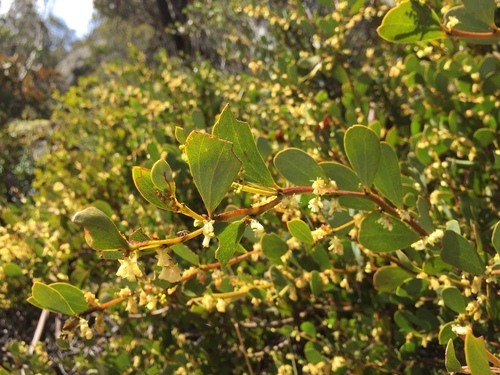
Acacia alpina F.Muell. is an erect, spreading, or tangled shrub that typically reaches 1 to 2 metres (3 ft 3 in to 6 ft 7 in) in height, and can grow up to 10 metres (33 ft) wide.
Phyllode Shape
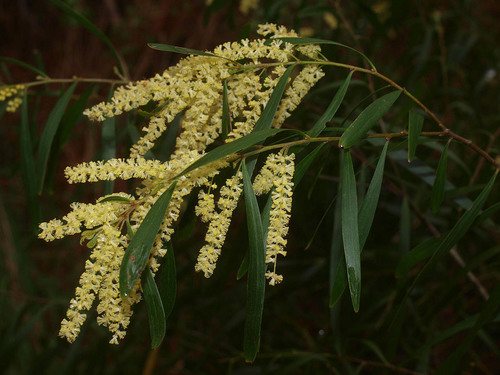
Its phyllodes are asymmetrical, and shaped like eggs, broadly eggs, or roughly round.
Phyllode Size
They measure 15 to 35 millimetres (0.59 to 1.38 in) long and 8 to 25 millimetres (0.31 to 0.98 in) wide.
Stipule Characteristics
A D-shaped stipule grows at the base of each phyllode, but drops off as the phyllode matures.
Flower Appearance and Arrangement
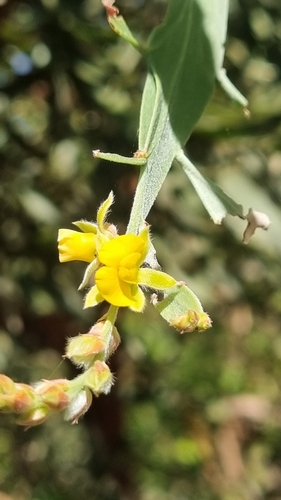
The flowers are usually pale yellow, and grow in 1 or 2 cylindrical to oblong spikes that are 5 to 15 millimetres (0.20 to 0.59 in) long.
Inflorescence Position and Peduncle
These spikes are located in the axils of phyllodes, and each spike holds a small number of flowers on a 1 to 3 millimetre (0.039 to 0.118 in) long peduncle.
Flowering Period
Flowering occurs mainly between October and November.
Fruit Shape
The fruit this species produces is a thin-walled pod that is gently curved or coiled.
Pod and Seed Size
The pods measure 30 to 80 millimetres (1.2 to 3.1 in) long and 3 to 6 millimetres (0.12 to 0.24 in) wide, and contain narrowly elliptic seeds that are 3.5 to 5 millimetres (0.14 to 0.20 in) long.
Common Name and Habitat Types
This species, commonly called alpine acacia, grows in woodlands, heathlands, and open plains.
Geographic Range and Altitude
Its range covers the Snowy Mountains of New South Wales, southern parts of the Australian Capital Territory, and extends south to around Mount Baw Baw in the eastern Victorian highlands, growing at altitudes between 1,300 and 1,800 metres (4,300 to 5,900 ft).
Substrate and Growth Habit
It is commonly found in granitic, windswept areas, and sometimes forms dense thickets.
Related Species and Hybridization
It is a close relative of Acacia phlebophylla, and the two species often hybridize.
Natural Distribution
This species occurs naturally in the alpine and subalpine areas of Australia.