About Acacia acinacea Lindl.
Scientific name: Acacia acinacea Lindl.
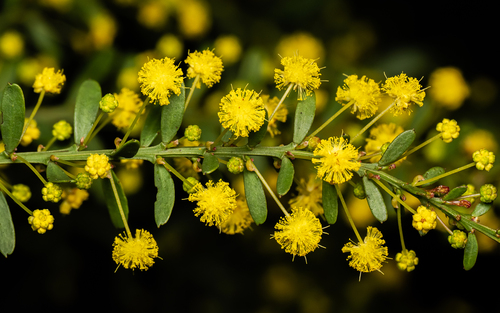
Description: Acacia acinacea, commonly called gold dust wattle, is an open, bushy or straggling shrub that usually reaches around 2.5 m (8 ft 2 in) in height. Its phyllodes are asymmetric, shaped narrowly oblong, lance-shaped, or egg-shaped with the narrower end toward the base. They measure 4–15 mm (0.16–0.59 in) long and 2–8 mm (0.079–0.315 in) wide, with a small point located off-set from the phyllode tip. It typically blooms prolifically between July and November, producing one or two spherical flower heads in each leaf axil. Each flower head is 4 to 4.5 mm (0.16 to 0.18 in) in diameter and holds 8 to 20 golden-yellow flowers. The seed pods are spirally coiled to twisted, 3.0–4.5 mm (0.12–0.18 in) wide, glabrous, and have a hard outer surface. The seeds are shiny, more or less oblong, 4 to 5 mm (0.16 to 0.20 in) long, and feature a club-shaped aril that grows up to half the length of the seed.
Distribution: Gold dust wattle has a wide distribution: it occurs from near Melrose in South Australia (including the Mount Lofty Ranges, Kangaroo Island, and southern Flinders Ranges), across most of Victoria, and south of the Gilgandra district in New South Wales. It most often grows in hilly terrain, and thrives in sand, sandy loam, and gravelly soils. It is a component of Eucalyptus woodland, woodland heath, and open mallee scrubland plant communities.