About Abutilon theophrasti Medik.
Scientific name: Abutilon theophrasti Medik.
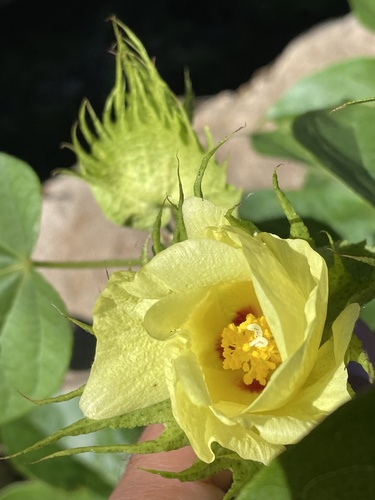
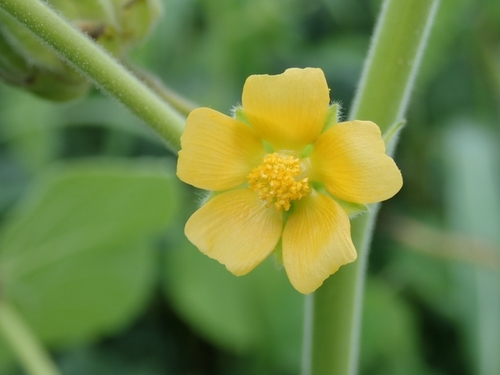
Botanical Description Velvetleaf is an annual plant that grows 3–8 feet tall, with branched, stout stems covered in downy hairs. It grows during warmer seasons: germinating in spring and flowering in summer. Its leaves are large, heart-shaped with pointed tips, arranged alternately along the stem. Leaves attach to thick, long petioles, and release an odor when crushed. The plant produces yellow flowers up to 1 inch in diameter, each with five petals attached at the base. Flowers grow on stalks, and occur either in clusters or singly at the junction of the stalk and leaf petiole. Velvetleaf produces pod-like capsules formed from 12–15 woody segments arranged into cup-like rings. Segments stay joined as seeds mature, and mature seeds are released through vertical slits on the outer surface of the capsule once development is complete.
Reproduction Each individual velvetleaf plant produces between 700 and 44,200 seeds. After pollination, seeds take 17–22 days to reach maturity. Seeds can remain viable for approximately 50 years when stored in dry conditions or remain buried in soil. Each carpel opens via a vertical slit along its outer edge to release seeds for dispersal. Successful seed germination requires temperatures between 24 and 30 °C. Velvetleaf can grow in a range of soil types, including gray-brown podzols, sandy soils, and clay loams, with an ideal soil pH range of 6.1 to 7.8, varying by location.
Cultivation and Medicinal Uses Velvetleaf has been cultivated in China since approximately 2000 BCE for its strong, jute-like bast fiber. In the Maldives, the plant is called maabulha, and its leaves are a traditional ingredient in Maldivian cuisine: they are typically finely chopped and mixed with Maldives fish and grated coconut to make the dish mas huni. Its seeds are eaten in China and Kashmir. The plant is used to produce ropes, coarse cloth, nets, paper, and boat caulk, and it is still cultivated in China today. In traditional Chinese medicine, velvetleaf is used to treat dysentery and eye injuries, including corneal opacity. The leaves contain 0.01% rutin, and are used as a soothing lubricant to soften irritated tissues. Softened leaves can also be used as a remedy for ulcers. The bark of velvetleaf can reduce discharge of bodily fluids including blood, secretions, and mucus, and promote urine flow.