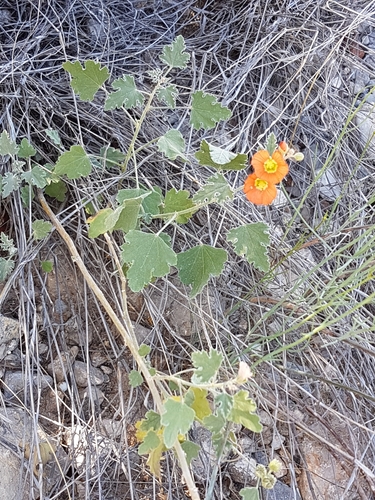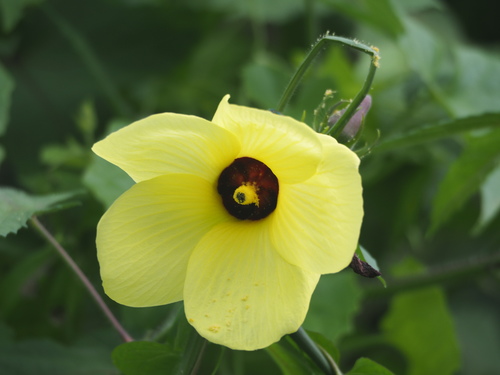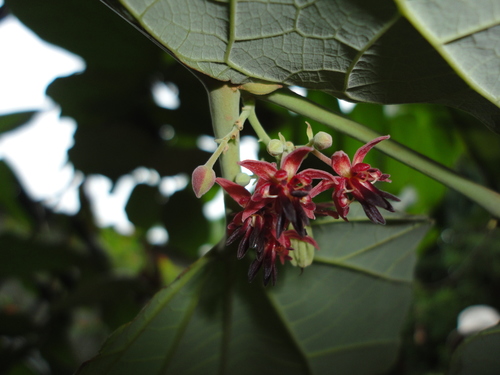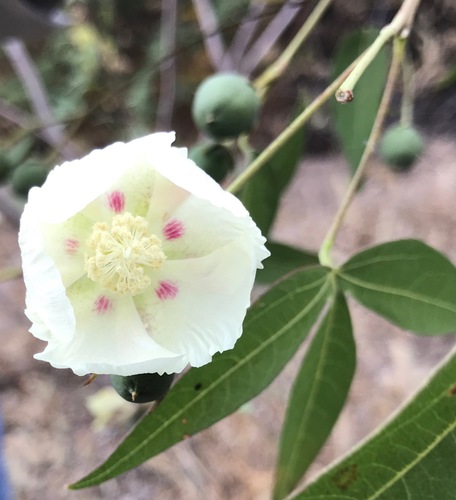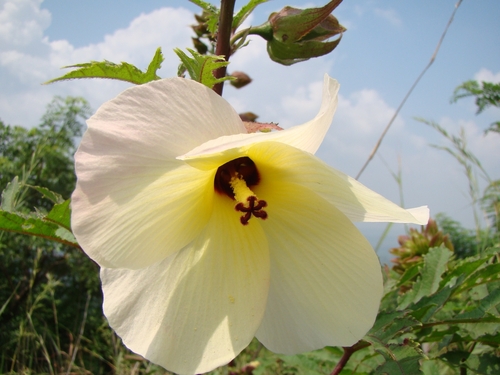
About Abelmoschus manihot (L.) Medik.
Growth Form and Size
Under favorable growing conditions, aibika (scientific name Abelmoschus manihot (L.) Medik.) can grow as a subshrub or shrub reaching over 3 metres (10 ft) in height.
Native Distribution
It is a tropical plant native to the Indian subcontinent, Indochina, central and southern China, Malesia, New Guinea, and Queensland.
Propagation and Disease Resistance
Aibika is easily propagated through cuttings and is relatively resistant to disease.
Cultivation Practices
Because of these traits, it is widely cultivated, and is often grown along garden borders or as an intercrop in traditional tropical gardens.
Horticultural Popularity
Its growth habit, combined with its nutritional value, makes it popular for home gardening and horticulture.
Non-Culinary Uses Overview
Beyond its culinary uses, aibika has other applications in different cultures.
Mucilage Application in Papermaking
Its mucilage is used in traditional papermaking.
Use in Japanese Washi Paper Production
In Japan, where it is called tororo aoi, it is used to produce neri, a starchy substance needed for making traditional Japanese washi paper.
Use in Korean Hanji Paper Production
In Korea, it is known as hwang chok kyu, and is used to make dak pul, an ingredient for producing Korean hanji paper.