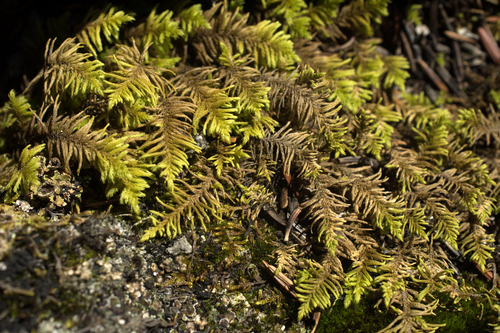
About Abietinella abietina (Hedw.) M.Fleisch.
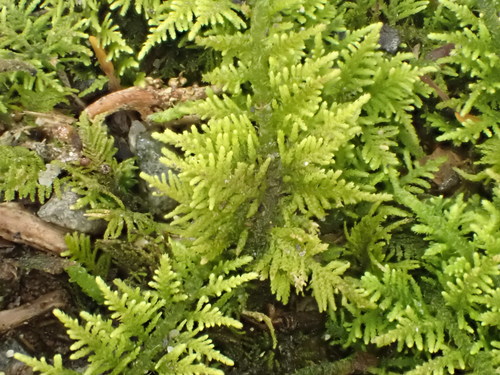
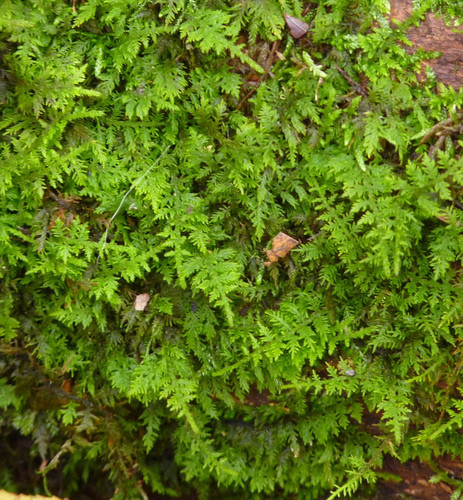
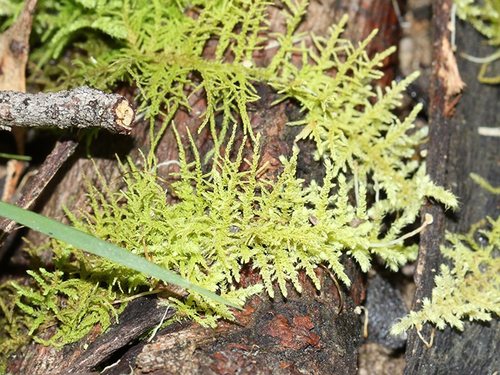
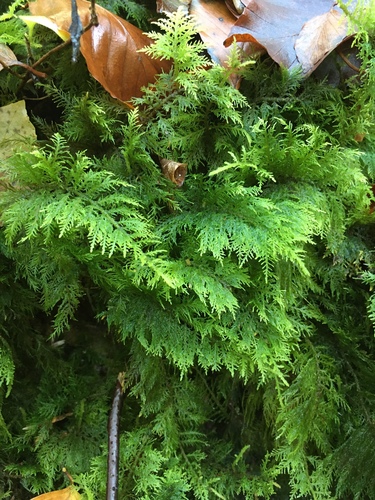
The shoots of Abietinella abietina are either green or dark brown, with shoot tips usually being yellow or green. Shoots are once-pinnate, with branches arranged in four rows (two rows on each side of the stem) across two planes. Secondary stems grow to around 5–10 cm long. Stem leaves of Abietinella abietina are broad, oval-shaped, longitudinally ridged, and have a broad base, and are larger than the smaller branch leaves. This species can produce primary stems 2–8 cm long, rarely reaching 12 cm. Branches grow from these stems in four ranks, and often spread at wide angles, resulting in sparse branching. The species' leaves are broadly ovate, spreading, plicate (folded) at the base, and taper to a long acuminate (pointed) apex. Branch leaves are relatively concave, range from broadly ovate to lanceolate, and have a noticeably shorter apex. Abietinella abietina prefers shallow soil, most commonly in unimproved grassland overlying calcareous sandy soil, and also grows in dune slacks and quarry banks. It very rarely occurs on base-rich slopes or mountain rocky ledges, and encounters of the species in these latter habitats are extremely uncommon.