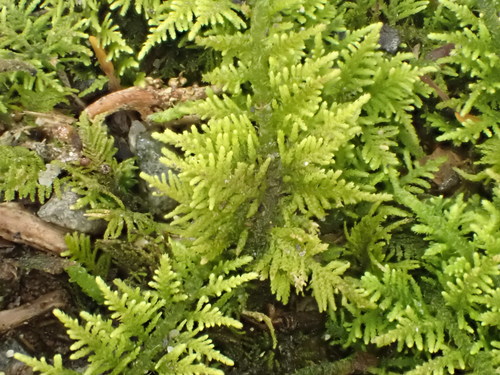
About Thuidiopsis furfurosa (Hook.f. & Wilson) M.Fleisch.
Taxon Identity
This moss species, Thuidiopsis furfurosa, has a dioecious gametophyte with a range of distinct characteristics.
General Color and Branching
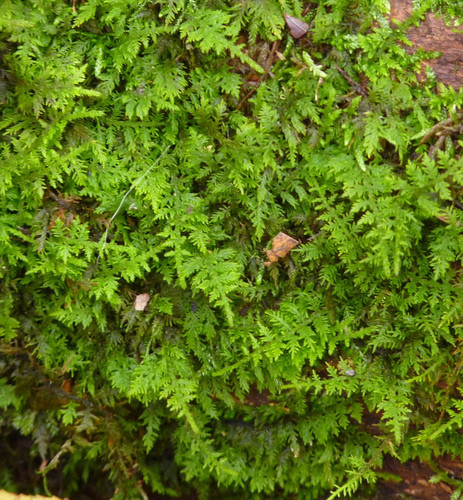
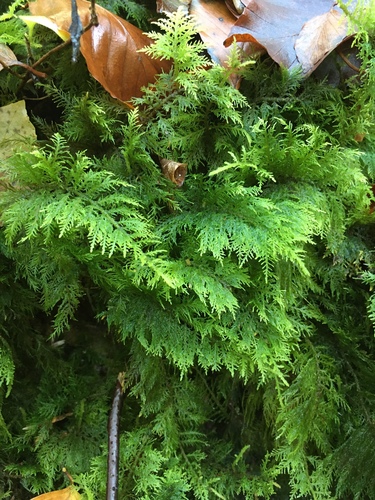
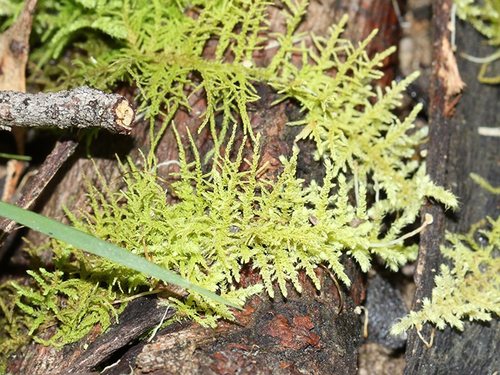
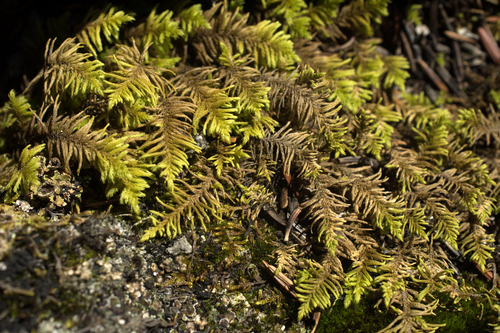
Its plants are typically colored from yellowish-green to dull green, and have bipinnate to indistinctly pinnate structures.
Stem and Branch Dimensions
Creeping stems of the moss grow 12 to 25 cm (4.7 to 9.8 in) long, and most often have pinnate or bipinnate branches 1 to 1.5 cm (0.39 to 0.59 in) long that form feathery fronds.
Specialized Branch Features
A notable feature is its tall, prominent scale-like leaves, while smaller lower branches of the plant are loose and chain-like (catenulate) when dry.
Stem Leaf Morphology
Stem leaves are most commonly triangular with blunt or pointed tips, narrowly triangular, or subulate, growing up to 2 mm (0.08 in) long.
Lower Branch Leaf Dimensions
Leaves on smaller lower branches have narrowly acute apices and measure 0.25 to 0.50 mm (0.01 to 0.02 in) long.
Costa Cell Characteristics
The abaxial epidermal cells of the costa may be smooth or have distal teeth.
Median Leaf Cell Papillae
Median leaf cells are usually unipapillose, occasionally 2- or 3-papillose, and their papillae are most often tall, acute, and curved.
Perichaetial Leaf Trait
Inner perichaetial leaves are ciliate.
Growth Form and Substrates
This moss forms compact to loose mats on a variety of substrates including soil, rocks, and wood.
Sporophyte Presence
During its reproductive phase, a distinct sporophyte is visible.
Calyptra Morphology
Calyptrae are hooded (cucullate), and may either have hairs at the base or be smooth.
Seta Characteristics
Setae range in color from red to orange, and can reach 3 cm (1.2 in) in length.
Capsule Shape
Capsules are inclined to pendent from their attachment point, and can be narrowly ovoid, ellipsoid, oblong, or cylindrical in shape.
Capsule Size and Contents
Capsules measure up to 2.5 to 3 mm (0.10 to 0.12 in) long, and contain spores inside.
Reference Image Collection
The University of Auckland holds an excellent collection of images of Thuidiopsis furfurosa that show its physical characteristics.
Wet Habitat Morphology
Plants that grow in very wet, shaded locations may develop irregular branching, and may have a reduced number and size of small branched scaly areas between leaves, called paraphyllia and pseudoparaphyllia.
Chromosome Counts
Two distinct chromosome counts have been recorded for this species: one population has n=11 chromosomes, and another has n=22 chromosomes.
Distribution Overview
Thuidiopsis furfurosa has a wide distribution.
Australian Distribution
It is found across multiple regions of Australia, including southern New South Wales, the Australian Capital Territory, Victoria, and Tasmania.
Oceanic Distribution
It is widespread across most of New Zealand, and is also present on Norfolk Island, Macquarie Island, the Society Islands, Juan Fernandez Islands, Tristan da Cunha, and Gough Island.
Potential Distribution
It possibly occurs in peninsular India.
Common Habitats
This moss most commonly lives in moist shaded environments, such as wet eucalypt (sclerophyll) forests, woodlands, rainforests, swamps, subalpine grasslands, and along creeks and streams.
Open Habitat Adaptability
It occasionally forms large patches in grasslands and open bush, showing it can adapt to a variety of environments and elevations.
Elevation Range
It grows from sea level up into the alpine zone, with recorded occurrences reaching approximately 1,600 meters (5,200 ft) above sea level in Victoria.