About Abies guatemalensis var. jaliscana Martínez
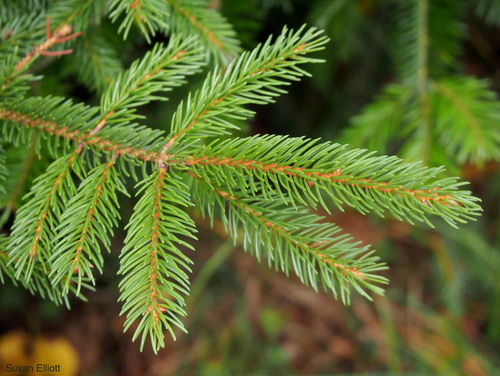
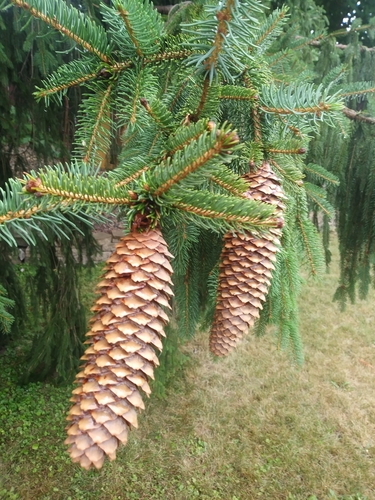
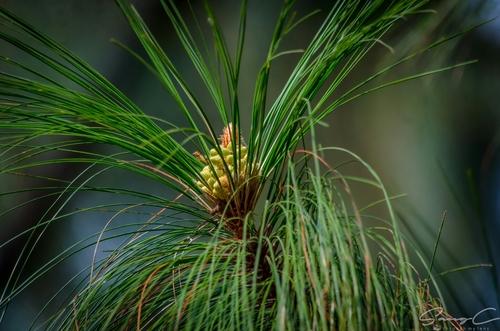
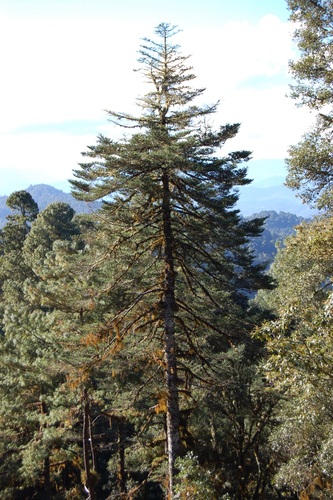
This text describes Abies guatemalensis, of which Abies guatemalensis var. jaliscana Martínez is a variety. A. guatemalensis is a conical tree that grows 20 to 35 meters tall, with a trunk girth of 60 to 90 cm. Most of its branches grow horizontally. Its bark is blackish-brown and divided into plates. Branchlets range from reddish-brown to deep blackish-red, and are covered in fine soft hairs. The buds are globular-ovoid, resinous, and roughly 5 mm long. Leaves are arranged in a somewhat comb-like or nearly pectinate pattern. Leaves are unequal in size, deep green on the upper surface, and waxy in texture on the lower surface. They measure 1.5 to 5.5 cm long and 1.2 to 2 mm wide. Stomata are usually absent from the upper leaf surface, but form 8 to 10 lines on the lower surface. Leaves contain two marginal resin canals, and the leaf apex is notched and emarginate. Female cones are oblong-cylindric, with an apex that ranges from pointed to somewhat flattened. The cones are yellowish-brown with a violet bloom, and measure 8 to 11.5 cm long by 4 to 4.5 cm wide. Cone scales are oblong, or sometimes broader than they are long. Bracts are hidden, reach about half the height of the scale, and have a cuneate-obovoid shape. Seeds are light brown nuts up to 9 mm long, with a wing up to 1.5 cm long. A. guatemalensis is listed as endangered by the IUCN due to timber exploitation and habitat loss. It typically grows in deep fertile soils, which are desirable for local agriculture, especially for coffee plantations. The species was reported to be a common tree until the 1940s. Large populations may still exist in Honduras, but current data is deficient. Some evidence indicates that most remaining stands in Guatemala (with the exception of the forest of Los Altos de San Miguel Totonicapán) are usually no larger than 3 square kilometers. In addition, cone crops are irregular, and seed germination is typically poor. Among remaining populations, the forest of Los Altos de San Miguel Totonicapán in Guatemala hosts the largest and best-conserved stands, covering 52,000 acres (26,060 hectares). Even these stands are threatened by illegal logging. Due to its endangered status, harvesting this tree is illegal in some of its native countries, and it is listed in CITES Appendix I, which prohibits commercial international trade in wild-sourced specimens, including their parts and derivatives. The Central American And Mexico Coniferous Resources Cooperative (CAMCORE) has also started programs to protect the tree in the wild. In Mexico, A. guatemalensis occurs on the Pacific slopes of the Sierra Madre del Sur and the southern Sierra Madre Occidental, in the states of Chiapas, Oaxaca, Guerrero, Michoacan, Colima, Jalisco, Nayarit, and Zacatecas. Its typical habitat is on volcanic soils between 1800 and 3700 meters elevation, in cool, moist climates influenced by oceanic conditions.