About Abies cephalonica Loudon
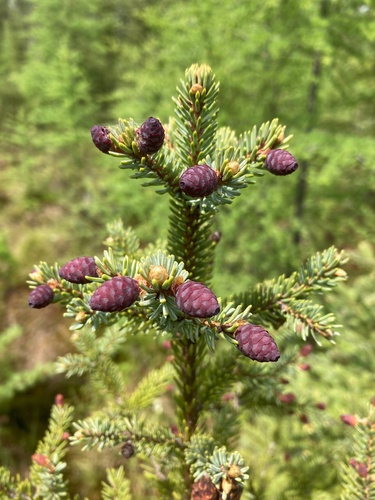
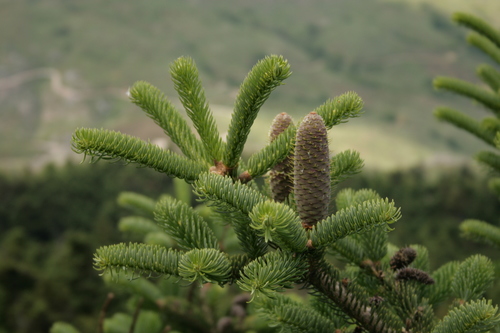
Abies cephalonica, commonly known as Greek fir or Cephalonian fir, is a fir species native to the mountains of Greece, primarily found in the Peloponnese and the island of Kefallonia. It intergrades with the closely related Bulgarian fir further north in the Pindus mountains of northern Greece, and is also closely related to the Nordmann fir found further east in northern Turkey. It is a medium-sized evergreen coniferous tree, growing to 25 to 35 metres (82 to 115 ft) tall, and rarely reaches 40 m (130 ft). It has a trunk diameter of up to 1 m (3 ft 3 in). This species grows at elevations between 900 and 1,700 m (3,000 to 5,600 ft), on mountains that receive over 1,000 millimetres (39 in) of rainfall annually. Its leaves are needle-like and flattened, measuring 1.5 to 3.0 cm (0.6 to 1.2 in) long, 2 mm (0.08 in) wide, and 0.5 mm (0.02 in) thick. The upper surface of the leaf is glossy dark green, while the lower surface has two blue-white bands of stomata. The leaf tip is pointed, usually fairly sharp, but may be blunt, especially on slow-growing shoots of older trees. Its cones are 10 to 20 cm (4 to 8 in) long and 4 cm (1.6 in) broad, holding around 150 to 200 scales. Each scale has an exserted bract and two winged seeds, and the cones disintegrate when mature to release their seeds. Greek fir is near-endemic to the Pindus Mountains mixed forests ecoregion. Along with black pine (Pinus nigra subsp. nigra) and Balkan fir (Abies × borisii-regis), it acts as a dominant tree in conifer forests between 1,200 and 2,500 meters elevation. It is less common in lower-elevation broadleaf mixed oak forests. In recent years, stress from prolonged drought and higher temperatures has made Greek fir trees vulnerable to infestation by wood-boring beetles of the subfamily Scolytinae. These beetles disrupt the tree's ability to transport water and nutrients from roots to branches, and can kill the trees. Greek fir population die-offs have been recorded in the Peloponnese, Ionian Islands, and the mountains of mainland Greece. In the past, Greek fir was important for producing wood used in general construction, but it is now too rare to hold significant commercial value. It is also cultivated as an ornamental tree for parks and large gardens. However, it is prone to frost damage in areas that commonly experience late frosts, because it is one of the first conifers to produce fresh new growth in spring.