About Abies alba Mill.
### Scientific name: Abies alba Mill.
### Description Abies alba (silver fir) is a large evergreen coniferous tree. It typically grows 40–50 m (130–160 ft) tall, with a trunk diameter up to 1.5 m (4 ft 11 in); the largest recorded specimen reaches 60 m (200 ft) tall with a 3.8 m (12 ft) trunk diameter.
It grows at altitudes of 300–1,700 m (980–5,580 ft), mostly above 500 m (1,600 ft), on mountains that receive over 1,000 millimetres (39 in) of rainfall annually.
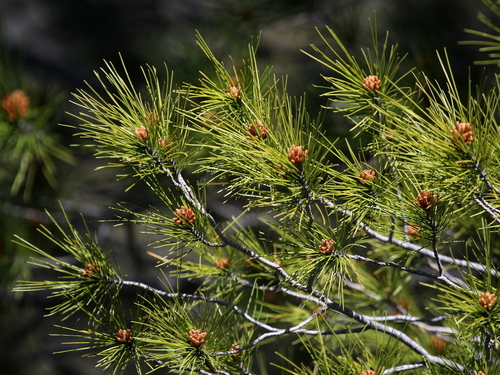
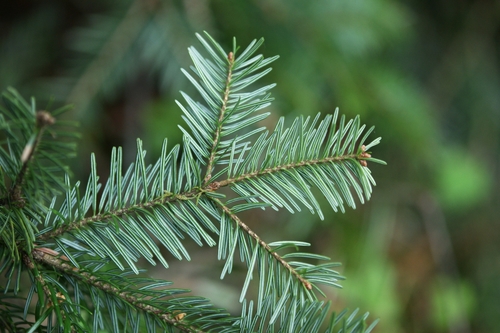
Its leaves are needle-like, flattened, 1.8–3.0 cm (0.71–1.18 in) long, 2.0 mm (0.079 in) wide, and 0.5 mm (0.020 in) thick. The upper leaf surface is glossy dark green, while the lower surface bears two greenish-white stomatal bands; the leaf tip is usually slightly notched.
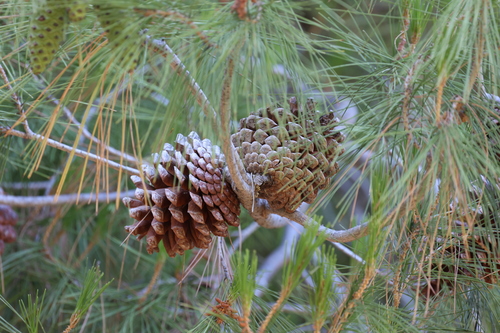
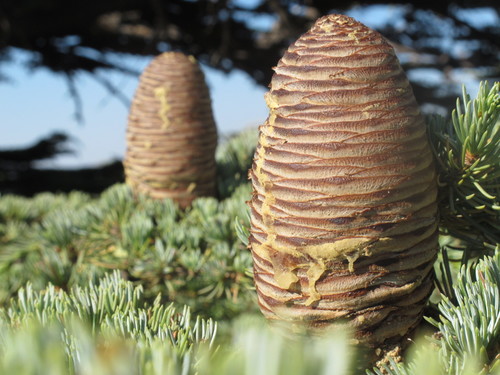
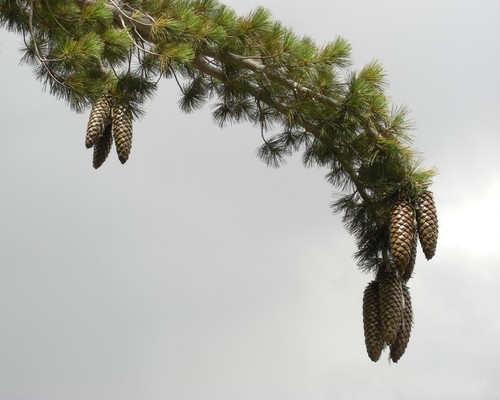
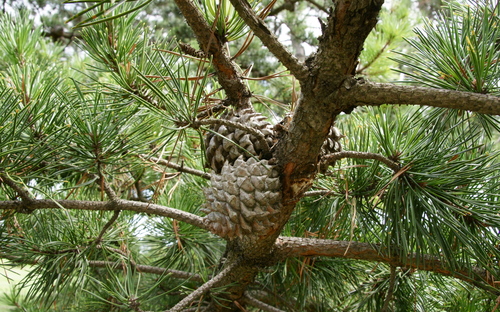
Its cones are 9–17 cm (3.5–6.7 in) long and 3–4 cm (1.2–1.6 in) broad, with around 150–200 scales. Each scale has an exserted bract and holds two winged seeds, and cones disintegrate when mature to release their seeds. The species' scientific epithet alba refers to its white wood.
In native forests, silver fir often grows in mixed stands with Norway spruce, Scots pine, and European beech. It is closely related to Bulgarian fir (Abies borisii-regis, native to the Balkan Peninsula further southeast), Spanish fir (Abies pinsapo, native to Spain and Morocco), and Sicilian fir (Abies nebrodensis, native to Sicily). It differs from these and other related Euro-Mediterranean firs by its sparser foliage, with leaves spreading on either side of the shoot that leave the shoot clearly visible from above. Some botanists classify Bulgarian fir and Sicilian fir as varieties of silver fir, as A. alba var. acutifolia and A. alba var. nebrodensis respectively.
### Ecology Silver fir is a key component species of the dinaric calcareous block fir forest in the western Balkan Peninsula. In Italy, it is an important component of mixed broadleaved-coniferous forests in the Apennine Mountains, especially the northern Apennines. It prefers cold, humid climates on north-facing slopes with annual rainfall over 1500 mm. In the eastern Italian Alps, it grows in mixed forests alongside Norway spruce, beech, and other tree species.
Caterpillars of the tortrix moth Cydia illutana feed on this species' cone scales, while caterpillars of Cydia duplicana feed on the bark around injuries or canker.
### Uses - In the Roman era, the wood was used to make wooden casks for storing and transporting wine and other goods. - A resinous, pine-scented essential oil can be extracted from the tree, which is used in perfumes, bath products, and aerosol inhalants. - Its branches (including leaves, bark, and wood) were historically used to make spruce beer. - Silver fir was the first species used as a Christmas tree, but has been largely replaced by Nordmann fir (which has denser, more attractive foliage), cheaper-to-grow Norway spruce, and other species. When grown on Christmas tree plantations, it naturally forms a symmetrical conical shape, with full dense growth and a resinous fragrance, and is known to retain its freshness longer than most other cut Christmas trees. In addition to cultivation within its native range, it is grown on Christmas tree plantations in northeastern North America, ranging from New England in the United States to the Maritime Provinces of Canada. - Its wood is strong, lightweight, light-coloured, fine-grained, even-textured, and long-fibred; the timber is primarily used for construction, furniture, plywood, pulpwood, and paper manufacture. - Honeydew produced by aphids feeding on silver fir is collected by honey bees, and the resulting product is sold as "fir honey".