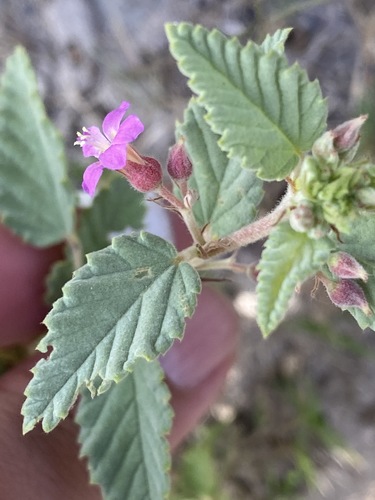
About Tilia americana L.
Tilia americana L., commonly called American basswood, is a medium-sized to large deciduous tree.
Mature Size
At maturity, it reaches 18 to 37 m (60 to 120 ft) in height, exceptionally up to 39 m (128 ft), with a trunk diameter of 1–1.5 m (3–5 ft).
Growth Rate
It grows faster than many North American hardwoods, often at twice the annual growth rate of American beech and many birch species.
Lifespan and Reproductive Timing
It has a life expectancy of around 200 years. Flowering and seeding generally occur between 15 and 100 years of age, though occasionally seed production may start as early as eight years.
Crown Structure
American basswood has a domed crown with spreading, often pendulous branches.
Bark Features
Its bark is gray to light brown with narrow, well-defined fissures.
Root System
It has large, deep, spreading roots.
Twig Characteristics
Twigs are smooth and reddish-green, turning light gray in their second year, and finally becoming dark brown or brownish-gray, marked with dark wart-like excrescences.
Winter Bud Features
Winter buds are stout, ovate-acute, smooth, and deep red, with two visible bud scales.
Leaf Shape and Size
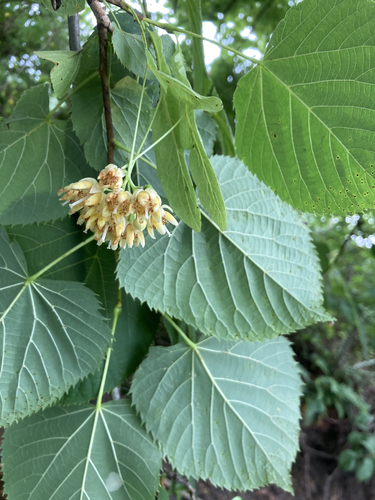
Leaves are simple, alternately arranged, ovate to cordate, asymmetrical, and unequal at the base (the side closer to the branch is larger). They are typically 10–15 cm (4–6 in) long and broad, but can grow up to 25 cm (10 in); William Jackson Bean noted that enormous leaves 38 cm (15 in) long by 25 cm (10 in) wide occasionally appear on thick, succulent shoots.
Leaf Development
Leaves emerge from the bud folded, pale green and downy. When fully grown, they are dark green, smooth and shining on the upper surface, paler beneath, with tufts of rusty brown hairs in the axils of the primary veins.
Stipules and Fall Foliage
Small stipules fall off soon after the leaf opens. Fall foliage is yellow-green to yellow.
Leaf and Twig Sap
Both twigs and leaves contain mucilaginous sap.
Flower Structure and Arrangement
Flowers are small, fragrant, yellowish-white, 10–14 mm (13⁄32–9⁄16 inch) in diameter, arranged in drooping cymose clusters of 6–20. A whitish-green leaf-like bract is attached for half its length at the base of the cyme.
Floral Morphology
Flowers are perfect and regular, with five sepals and petals, numerous stamens, and a five-celled superior ovary.
Day Length Requirement for Flowering
Leaves emerge in mid-spring, but flower formation requires approximately 14 hours and 30 minutes of day length, which limits T. americana’s range to areas north of the 35th parallel.
Flowering and Leaf Drop Timing
Flowering time varies by several weeks depending on latitude: it occurs in early May in Canada and early June at the extreme southern extent of the species’ range. Leaf drop in fall happens between early and late October depending on latitude.
Pollination and Fruit Features
Flowers are fragrant and insect-pollinated. The fruit is a small, globose, downy, hard and dry cream-colored nutlet 8–10 mm (5⁄16–13⁄32 in) in diameter.
Forest Habitat Association
American basswood is the dominant tree in the sugar maple–basswood forest association, which is most common in western Wisconsin and central Minnesota. This association occurs as far east as New England and southern Quebec in areas with mesic soil that has a relatively high pH.
Occurrence in Other Forest Types
The species also occurs in small numbers in many other forest cover types.
Faunal Interactions
Its flowers provide abundant nectar for insects. Chipmunks, mice, and squirrels eat its seeds. Rabbits and voles eat the bark, sometimes girdling young trees. Leaves serve as food for caterpillars of various Lepidoptera that feed on Tilia; the ribbed cocoon maker species Bucculatrix improvisa has not been found feeding on any other plant.
Pests and Pathogens
This species is particularly susceptible to adult invasive North American Japanese beetles, which feed on its leaves. The mushroom Pholiota squarrosoides is known to decay fallen logs of this tree.
Coppicing Reproduction
T. americana mostly spreads by self-coppicing rather than seeds. Juvenile basswoods coppice readily, and even old trees may sprout from the stump after cutting.
Seed Viability and Germination
T. americana seeds have a low viability rate of approximately 30%, and develop an unusually hard seed coating after reaching maturity, which can delay germination for up to two years. Gathering seeds in early autumn and sowing before they dry out and form this harder coating can bypass this delay.
Ornamental and Windbreak Use
American basswood is recommended as an ornamental tree when dense foliage or deep shade is desired, and no native North American tree outperforms it in this respect. It is often planted on the windward side of orchards to protect young, delicate trees.
Cultivation Range
It is cultivated at least as far north as Juneau, Alaska.
Edible and Pollinator Benefits
Both its foliage and flowers are edible, though tender young leaves are more palatable. It is a beneficial species for attracting pollinators. Bees produce excellent honey with a mildly spicy flavor from its blossoms.
Historical Fiber Use
Historically, its inner bark was used as a fiber source to make baskets, rope, and fishing nets.
Pest Susceptibility
Basswood is susceptible to many insect pests including Japanese beetles, and skeletonized leaves are common. Mite galls also frequently form on its foliage.
Cultivars and Introduction to UK
Cultivars of the species include 'Nova', 'Duros' (which has an upright crown), the pyramidal 'Frontyard', and the conic-crowned 'Redmond'. The tree was introduced to the UK in 1752, but has never prospered there, as it is prone to dieback.
Medicinal Use Context
Although Tilia cordata is considered a stronger medicinal plant, T. americana is also used medicinally. Dried flowers of T. americana are mildly sweet and sticky, and the fruit is somewhat sweet and mucilaginous.
Linden Tea Properties
Linden tea made from its flowers has a pleasing taste, thanks to the aromatic volatile oil the flowers contain.
Medicinal Plant Parts
Flowers, leaves, wood, and charcoal produced from the wood of the species are all used for medicinal purposes.
Active Constituents
Active ingredients in Tilia americana linden flowers include antioxidant flavonoids, volatile oils, and mucilaginous constituents that soothe and reduce inflammation. The plant also contains tannins that act as an astringent.
Flower Medicinal Applications
Linden flowers are used to treat colds, cough, fever, infections, inflammation, high blood pressure, and headache (particularly migraine); they also act as a diuretic that increases urine production, an antispasmodic that reduces smooth muscle spasm along the digestive tract, and a sedative. Flowers were added to baths to calm hysteria, and steeped as a tea to relieve anxiety-related indigestion, irregular heartbeat, and vomiting.
Leaf, Wood, and Charcoal Uses
Leaves are used to promote sweating to reduce fevers. Wood is used to treat liver and gallbladder disorders and cellulitis, an inflammation of the skin and surrounding soft tissue. Wood burned into charcoal is ingested to treat intestinal disorders, and used topically to treat edema or infection such as cellulitis or lower leg ulcers.
Sedative Effect Research
Several animal studies have shown that T. americana extract increases sleeping time by 50 minutes, a similar effect to diazepam, and decreases movement, confirming its sedative effects. It has been proposed that this mechanism of action comes from the flavonoid quercetin, which inhibits the release of histamine.