About Zygoballus sexpunctatus (Hentz, 1845)
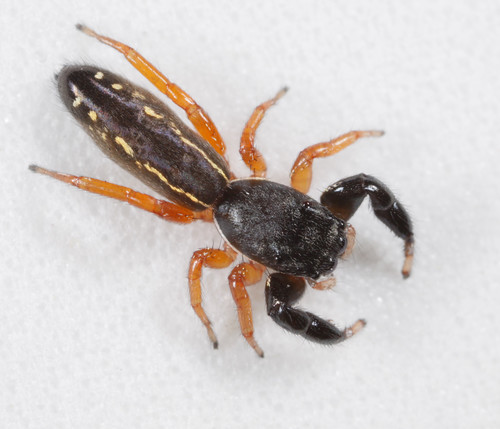
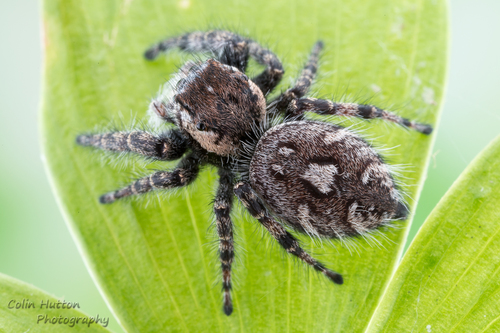
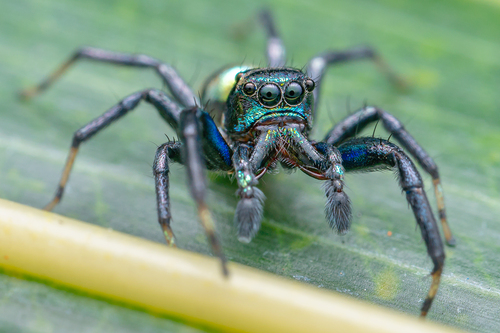
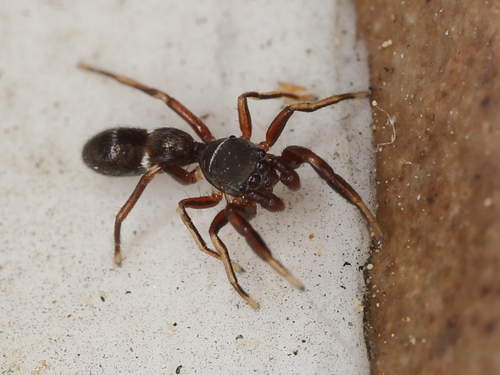
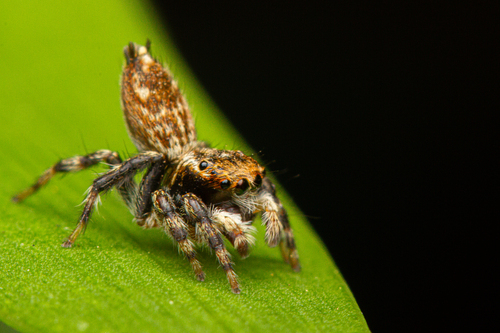
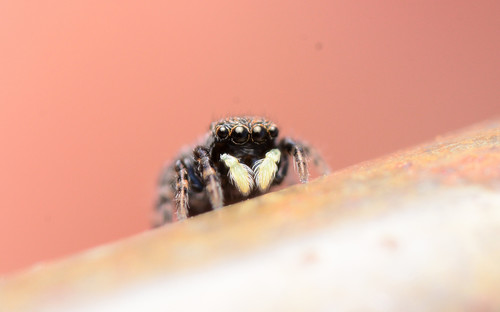
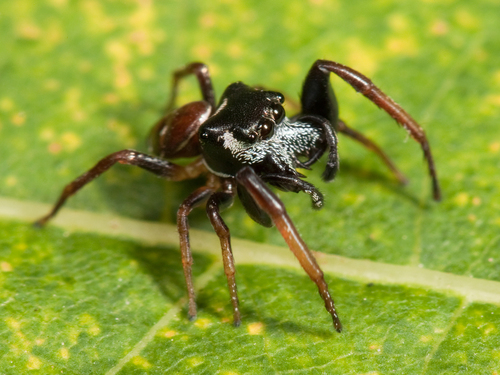
Zygoballus sexpunctatus (Hentz, 1845) is a species of jumping spider in the genus Zygoballus. According to arachnologist B. J. Kaston, adult females measure 3.5 to 4.5 mm in body length, while adult males measure 3 to 3.5 mm. An earlier description by the Peckhams gives different body length measurements: 3 mm for females, and 3 to 4.5 mm for males. The cephalothorax of Z. sexpunctatus ranges in color from bronze to black. Like all Zygoballus spiders, the cephalothorax has a box-like shape, and is widest at the posterior lateral eyes. Numerous white or pale blue scales cover the clypeus (the "face") and chelicerae; this scaled covering extends around the sides of the carapace, and ends beyond the posterior median eyes. In males, the labium is two-fifths as long as the maxillae, and is as wide as it is long. Males have greatly enlarged, obliquely oriented chelicerae, with each chelicera bearing a prominent inner tooth and a long, curved fang. The legs are reddish brown, or sometimes yellowish. The femora of the anterior (first) pair of legs are darker and enlarged, particularly in males. The anterior legs have three pairs of long spines on the ventral surface of the tibia, and two pairs of spines on the metatarsus. The Peckhams recorded the following leg lengths for a male specimen, starting from the anterior pair: 3.7 mm, 2.2 mm, 2 mm, 3 mm. In females, the fourth pair of legs is the longest. The male pedipalp has a single tibial apophysis that tapers gradually. The abdomen ranges from bronze to black, with a white basal band and two white transverse bands. These transverse bands are often broken to form six spots, though some or all of these spots may be absent. Zygoballus sexpunctatus is similar in appearance to Zygoballus rufipes, and the two species have overlapping ranges. Males can be distinguished from Z. rufipes by the large spot of white scales at the start of the thoracic slope (a feature that is absent in Z. rufipes), and by the shape of the palpal bulb. Females can most easily be distinguished by the form of the epigyne, the external genital structure. The species' range stretches from New Jersey to Florida, and extends west to Texas. It is most commonly found in the southern United States. Nicholas Marcellus Hentz collected the original type specimen in North Carolina. In 1909, the Peckhams reported that the species had been collected from North Carolina, Florida, Texas, Louisiana, and Mississippi. A seven-year survey of spider species in western Mississippi recorded Z. sexpunctatus as "uncommon" in abundance. A one-year survey in Alachua County, Florida, recorded the species as "rare". Specimens have been collected from multiple ecosystems, including old fields, river terrace forests, flatwoods, Florida Sand Pine scrub, Slash Pine forests, Appalachian grass balds, and rice fields. Robert and Betty Barnes reported that the species occurs in broomsedge fields throughout the southeastern Piedmont. Zygoballus sexpunctatus typically inhabits the herb stratum, among grasses and other short plants, and can be collected using a sweep net. Like most spiders, Zygoballus sexpunctatus is an opportunistic feeder that preys on a wide range of invertebrates. Its typical diet includes small insects such as aphids and young caterpillars. It is also known to eat mosquitoes and many kinds of small spiders. Mud dauber wasps, which capture and paralyze spiders to feed their larvae, have been documented preying on both male and female Z. sexpunctatus. In a study of spider populations in western Tennessee, Zygoballus sexpunctatus spiderlings were recorded hatching from egg sacs in mid summer. The immature spiders hibernate over winter, and reach sexual maturity around late April.