About Zostera marina L.
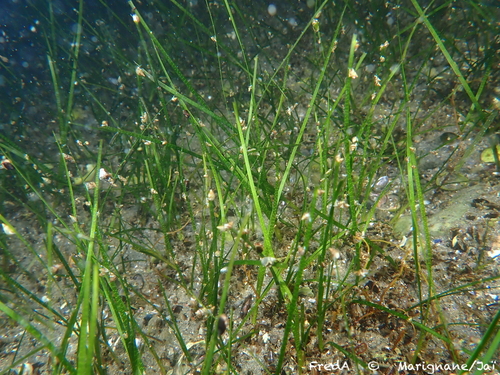
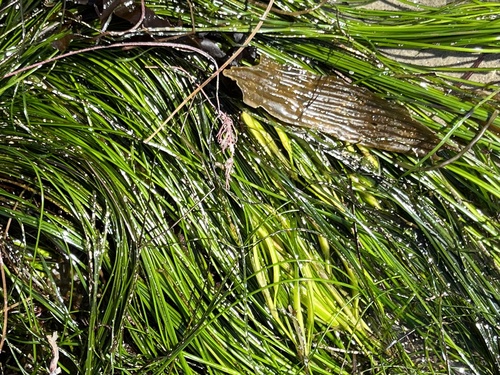
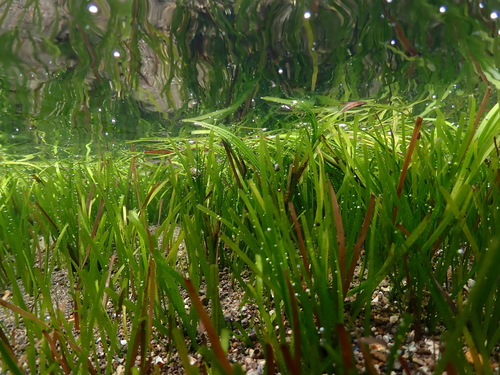
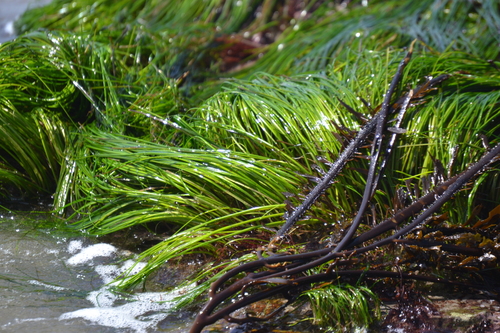
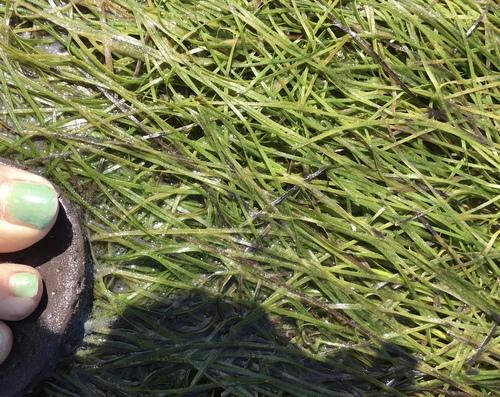
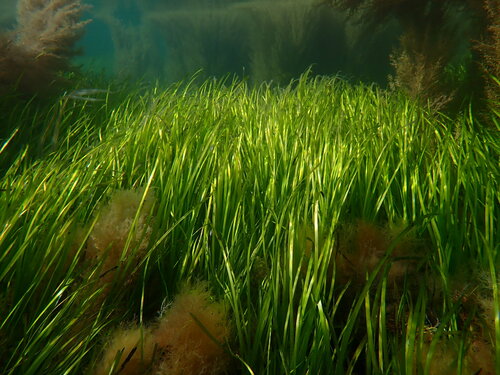
Zostera marina L. is a rhizomatous, flowering marine herb. It produces long stems bearing hairlike green leaves that can reach over 1.0 metre (3 ft 3 in) in length and measure up to 1.2 centimetres (0.47 in) wide. It is typically a perennial plant, though it may also grow as an annual. Its rhizome grows horizontally through the substrate, anchoring the plant via clusters of roots at rhizome nodes. This species is monoecious: a single individual bears both male and female flowers arranged in separate, alternating clusters. Its inflorescence grows to around 10 cm long, and its fruit is a nutlet with a transparent coat surrounding the seed. It can reproduce both sexually and vegetatively. For vegetative reproduction, it sprouts repeatedly from its rhizome, spreading to form a meadow-like colony on the seabed called a genet. One genet of cloned eelgrass has been confirmed to be 3000 years old genetically. When reproducing sexually, the plant produces large quantities of seeds, sometimes reaching several thousand seeds per square meter of growth. When stems break away from the parent colony, they carry fertile seeds over long distances to new areas before eventually dropping the seeds onto the seabed. This seagrass is a preferred food for several waterfowl species, which also help disperse its seeds.
This species is the most widely distributed marine flowering plant in the Northern Hemisphere, and the most widespread seagrass species across the temperate northern regions of the Atlantic and Pacific Oceans. It lives in cooler ocean waters of the North Atlantic and North Pacific; in the warmer southern parts of its range, it dies off during warm seasons. It grows in the Arctic region and can endure several months of ice cover each year. It is the only seagrass species known to occur in Iceland. It can be found in bays, lagoons, estuaries, on beaches, and other coastal habitats. It has several ecotypes, each with its own specific habitat requirements. It grows in calmer waters of the sublittoral zone, where it is rarely exposed to air. It anchors in sandy or muddy substrates via its rhizomes, and its leaves catch floating particulate debris that accumulates around the plant bases, gradually building up the top layer of the seabed. This Zostera grows on muddy and sandy shores only at and below the spring tide line.
This plant is an important member of coastal ecosystems in many areas, as it helps physically form habitat and plays a critical role supporting many other species. It provides sheltered spawning grounds for Pacific herring (Clupea pallasii). Juvenile Atlantic cod (Gadus morhua) hide in eelgrass beds as they develop. Blue mussels (Mytilus edulis) attach to its leaves. The endophytic green alga Entocladia perforans depends entirely on this eelgrass. Many animals rely on this plant for food, including the isopod Idotea chelipes and the purple sea urchin Paracentrotus lividus. The Atlantic brant (Branta bernicla hrota) survives almost entirely on this plant. When eelgrass dies, detaches, and washes onto beaches, it supports a whole new coastal ecosystem: many insect and other invertebrate species come to inhabit the dead plant material, including the amphipod Talitrus saltator, the fly Fucellia tergina, and the beetles Stenus biguttatus, Paederus littoralis, and Coccinella septempunctata. The bacterial species Granulosicoccus coccoides was first isolated from the leaves of Zostera marina.
Humans have used this plant for a range of purposes for a long time. In some regions, it has long been used as material for roof thatching. It has been used as fertilizer and cattle fodder in Norway for centuries. It has also been dried and used as stuffing for mattresses and furniture. The hunter-gatherer Seri people of Mexico toast and grind the plant's grains into an edible paste. Spanish chef Ángel León has planted Z. marina meadows (referred to as "sea rice") in the Bay of Cádiz to harvest the plant's grains. Its texture is described as falling between rice and quinoa, with a more saline flavor, and it is gluten-free and high in fibre.