About Zonotrichia querula (Nuttall, 1840)
This species, the Harris's sparrow, is the largest sparrow in the family Passerellidae, though other superficially dissimilar species in the family may be slightly larger. Its total body length ranges from 17 to 20 cm (6.7 to 7.9 in), it has a wingspan of 27 cm (11 in), and its body weight falls between 26 and 49 g (0.92 to 1.73 oz). For standard body measurements, the wing chord measures 7.7 to 9.2 cm (3.0 to 3.6 in), the tail measures 7.6 to 8.8 cm (3.0 to 3.5 in), the bill measures 1.1 to 1.4 cm (0.43 to 0.55 in), and the tarsus measures 2.2 to 2.5 cm (0.87 to 0.98 in).
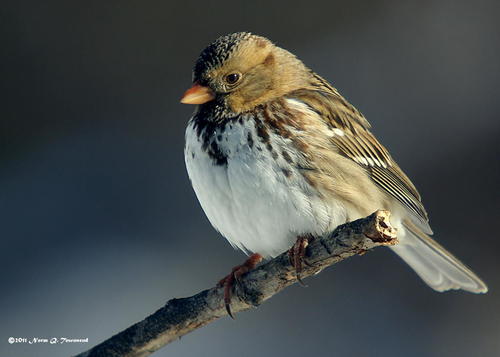
This is a very distinctive looking species. Birds in breeding plumage have conspicuous pink bills and black markings on the crown, face, throat, and upper breast, which contrasts with grey on the sides of the head and neck. The back is brown, covered with heavy black streaking, and there are two white wing bars. Breeding birds have white lower underparts with some black mottling on the flanks. Non-breeding adults are more buffy than grey and brown, with reduced or absent black markings, and often have whitish scalloping on the head and throat. Immatures have less black than any adult plumage, and are normally marked with a white chin and throat, a black malar stripe, and a broad smudgy black breast-band. Juveniles have a brownish crown streaked with black, fine dark streaks, and some broader black markings on the underside. Harris's sparrows moult between July and September.
Wintering Harris's sparrows can be confused with wintering Lapland longspurs (Calcarius lapponicus). However, Lapland longspurs have much shorter tails with white outer rectrices, rich rufous coloring in their greater coverts, and are strictly terrestrial on open ground. The song of the Harris's sparrow is usually delivered from a high perch. It consists of a series of one or more clear, high, wavering whistles, followed by another series at a higher or lower pitch. This species is also known to produce a strong, metallic chink call, as well as variable musical twittering.
Harris's sparrows breed in stunted coniferous forests and adjacent scrubs, particularly in areas of the grand boreal forests where spruce stands border mossy bogs. They often nest near the northern limit of tree growth in the forest-tundra ecotone. Common plant life in Harris's sparrow breeding grounds includes white spruce (Picea glauca), black spruce (P. mariana), American larch (Larix laricina), dwarf birch-willow, wet sedge meadow, and shrubby tundra with dwarf ericad/lichen plant life.
The species migrates mainly through tallgrass prairies to reach its winter range. During winter, it lives in open woodlands, woodland edges and clearings, hedgerows, dense riparian thickets, and around brush piles. Harris's sparrows regularly visit bird feeders in suburban and rural gardens during winter, and typically avoid dry shortgrass prairies and dense woods in this season. Migrating individuals may be attracted to marsh elder (Iva annua) and giant ragweed (Ambrosia trifida).
Harris's sparrows generally feed on the ground, scratching vigorously in leaf litter and soil to find food. Observation during the nesting season found that 85% of foraging activity is ground-gleaning. During the breeding season, individuals typically forage alone or with a mate. Seeds make up 66% of the stomach contents of breeding birds, making them the primary component of the species' diet. These seeds mostly come from Carex sedges, grasses, and Scirpus bulrush. Fruits are also an important part of the breeding season diet, mostly consisting of black crowberry (Empetrum nigrum), mountain bearberry (Arctostaphylos alpina), and various Vaccinium species. Pine needles, flower buds, and blossoms are eaten as supplemental food. Larval invertebrates are an important part of the diet from June to September, when prey becomes more abundant. The main preferred animal prey includes beetles, flies, bees, ants, moths, butterflies, spiders, cicadas, aphids, and leafhoppers. The diet of wintering Harris's sparrows is less well understood and has not been studied quantitatively.
Breeding pairs of Harris's sparrows establish territories of approximately 2 hectares (4.9 acres). Nests are usually built in early to mid-June, and eggs are usually laid by late June to July, depending on when all snow in their habitat melts. For this species, nests are placed in well-hidden spots on the ground under a thick bush or small conifer, or in mossy depressions in thick clumps of grass. Both parents construct a cup-shaped nest from twigs, grass, moss, and lichens, and line it with fine grasses. Females lay between three and five eggs, which vary from greenish to greyish in color and have varying amounts of small reddish-brown spots. Eggs average 22.2 mm × 16.5 mm (0.87 in × 0.65 in) in size and weigh approximately 3.3 g (0.12 oz). Incubation lasts approximately 13.5 days. Chicks weigh about 3.1 g (0.11 oz) when they hatch. Young birds fledge after about 8 to 10 days, between July 4 and July 13. The young become independent of their parents around 3 weeks after fledging. If the first clutch is destroyed, pairs may lay a second clutch, which usually extends the brooding period by an additional three days.
This species is often considered the least studied North American sparrow, due to its isolated nesting territory. The first ever recorded Harris's sparrow nest was discovered in 1931 in Churchill, Manitoba by ornithologist George M. Sutton, 91 years after the species was first described.