About Zonotrichia capensis (P.L.S.Müller, 1776)
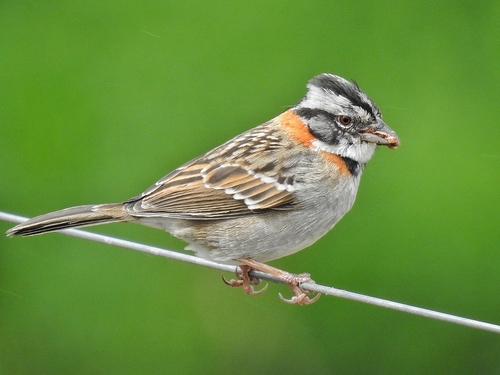
The rufous-collared sparrow, Zonotrichia capensis (P.L.S.Müller, 1776), measures 13.5–15 cm (5+1⁄4–6 in) in length and weighs 20–25 g (0.71–0.88 oz). Adult individuals have a stubby grey bill, and a grey head marked with broad black stripes along the crown sides, plus thinner stripes through the eye and below the cheeks. Their nape and breast sides are rufous, and their upperparts are buff-brown streaked with black. Two white wing bars are present on the wings. The throat is white, underparts are off-white, flanks are brown, and there is a black patch on the breast. Juvenile rufous-collared sparrows have a duller, less distinct head pattern, with brown stripes and a buff base colour. They do not have the rufous collar, and their underparts are streaked. There are 27 recognized subspecies of the rufous-collared sparrow. Generally, smaller subspecies are found in coastal mountains, intermediate-sized birds live in the Andes, and large, darker forms breed on the tepuis. The largest subspecies found on tepuis, Z. c. perezchincillae, has grey underparts, and its rufous collar extends across the breast as a freckled black band. This form may be distinct enough to be classified as a separate species, or it may simply be a particularly distinct population resulting from genetic bottleneck effects. Across the northern and western parts of the species' range, this generally abundant bird typically occurs at altitudes between 600–4,000 m (2,000–13,100 ft). In the southern and eastern parts of its range, it is commonly found down to near sea level. It can inhabit almost any open or semi-open habitat, including agricultural areas, gardens, parks, grasslands, and scrubby second growth or cerrado. It adapts well to urban and suburban environments, but is not present in the densely forested areas of the Amazon Basin. It is also scarce on the Guiana Shield, occurring mainly on some tepuis and in Guyana's Pakaraima Mountains. During the last glacial period, when climates were much cooler, the species was likely more widespread across the Caribbean region. Once temperatures warmed after the glacial period, it became isolated to the highest mountains of Hispaniola, which are the highest mountains in the Caribbean. This isolation pattern matches that of the Hispaniolan crossbill (Loxia megaplaga), a bird that shares the same range. The species is also known to occur on Aruba and several other Caribbean islands.