About Zonotrichia atricapilla (J.F.Gmelin, 1789)
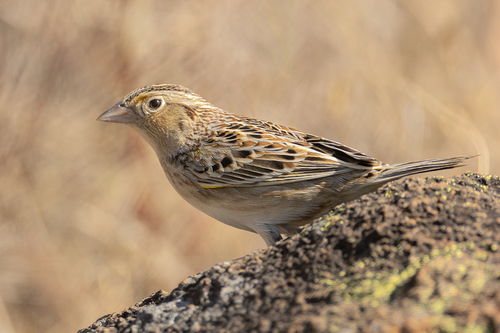
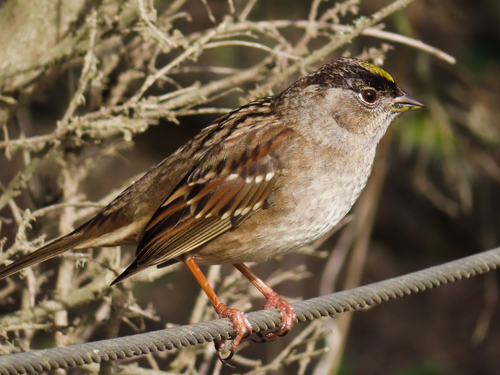
Zonotrichia atricapilla, commonly known as the golden-crowned sparrow, is a fairly large sparrow by American sparrow size standards. Adult individuals measure 15–18 cm (6–7 in) in length, have a wingspan of 24.75 cm (9.74 in), and weigh between 19.0 to 35.4 g (0.67 to 1.25 oz). Like all species in the Zonotrichia genus, this sparrow has a relatively long, square-tipped tail and a slightly peaked crown. Males and females have similar plumage, though males average slightly larger than females. For adult plumage: apart from a plain gray nape, the bird's upperparts are grayish-brown, marked with broad brownish-black streaks on the back and scapulars, and has an unstreaked rump. Its underparts are gray, slightly paler on the belly and more buff-colored on the flanks. Its wings and tail are brown, with two distinct white wing bars. It has pale brown legs, a dark bill where the upper mandible is darker than the lower mandible, and a brown iris. During the breeding season, adult golden-crowned sparrows develop a broad yellow central crown stripe that fades to pale gray toward the back of the head. This is a migratory species common along the western edge of North America. It breeds from north-central Alaska (including the Aleutian Islands west to Unimak Island) and central Yukon, south to the northwestern corner of the US state of Washington. It winters from southern coastal Alaska down to northern Baja California. It has been recorded as a vagrant in Japan and Russia, and occasionally strays as far east as the eastern coast of North America, ranging from Nova Scotia to Florida. During the winter, it generally occupies brushy areas, particularly chaparral, and usually stays in dense shrubs.