About Zonocerus variegatus (Linnaeus, 1758)
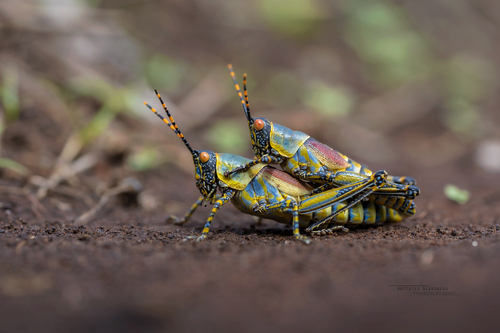
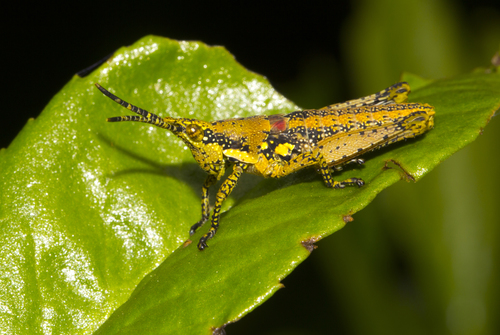
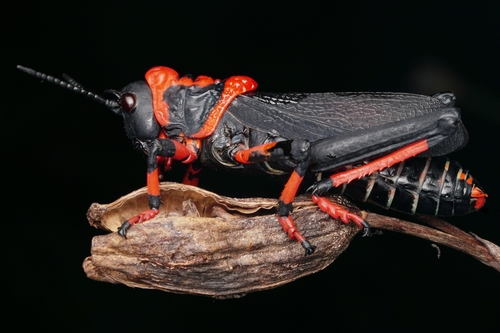
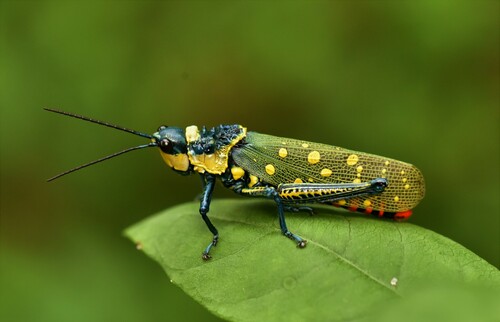
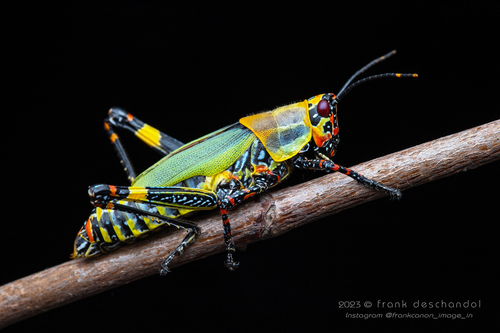
Adult Zonocerus variegatus grasshoppers are extremely colorful, with large red compound eyes, a body and legs boldly patterned in black, white, red, and yellow, and greenish membranous wings. Nymphs also have red eyes, but lack wings; they are black with yellow and white markings. Zonocerus variegatus is native to tropical West and Central Africa, and is an important agricultural pest in Ghana, Togo, Ivory Coast, Nigeria, Congo Brazzaville, Southern Benin, and the Sahel region. It is a polyphagous insect that feeds on many different plant species. Both nymphs and mature Zonocerus variegatus damage crops, especially cassava, groundnuts, and vegetables, and the species is linked to transmitting mosaic viruses that affect cowpea and okra. The most severe crop damage occurs in humid areas, on forest edges, and near recently cleared fallow ground that supports herbaceous plants. When forests are cleared, the plant Chromolaena odorata often colonizes the cleared area. This plant is a preferred food of Zonocerus variegatus, which causes the grasshopper populations to grow; the increased populations then spread to nearby cultivated areas. Perennial crops are less damaged by this species than annual crops. There is a long-standing tradition of eating insects across Africa and Asia, where insects are a high-quality source of animal protein that is nutritionally superior to beef and chicken. Grasshoppers are the most commonly eaten insect, and Zonocerus variegatus is a common species that has been eaten traditionally for centuries. In the dry season in northern Nigeria, these grasshoppers are gathered from grasses and bushes before dawn, when the insects are inactive. After collection, they have their wings removed, are salted, and then fried. Zonocerus variegatus contains approximately 10% chitin; derivatives of chitin are of interest in medical research, industry, and agriculture, for use in manufacturing biodegradable plastics, wound repair, as a crop booster, and as a nematicide and fungicide.