About Ziziphus nummularia (Burm.fil.) Wight & Arn.
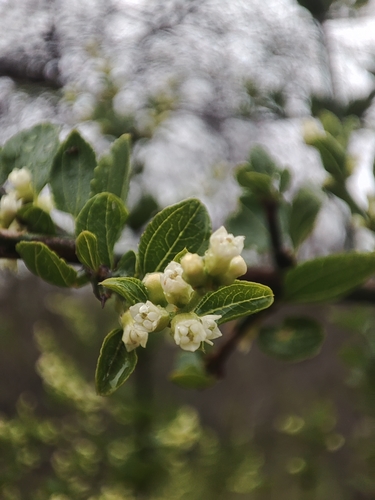
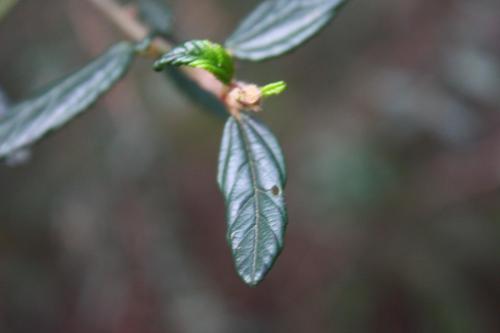
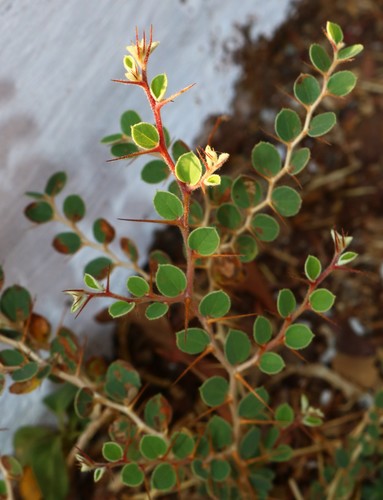
Ziziphus nummularia (Burm.fil.) Wight & Arn. is a heavily branched, broadly spreading, thorny bush or shrub that reaches a maximum height of 6 to 8 meters (20 to 26 feet). Its branches and twigs have a velvety texture and pale purplish color. Its lateral roots are long and extend deep into the growing substrate. Its leaves are alternately arranged, simple, and ovate, measuring 2.5 centimeters (1 inch) long with serrated margins. The upper surface of the leaf blade is dark green and glossy, while the lower surface is white and covered in fine, soft down. Its stipules are most often replaced by a pair of brown spines: one is a short, downward-curving hook, the other is robust, straight, and 1 centimeter (0.4 inches) long. Its inflorescences are cymes, and the individual pale yellow flowers are bisexual, have floral parts arranged in groups of five, and often lack petals. After flowering, the plant produces small red or blackish drupes that are no more than 1 centimeter (0.4 inches) in diameter. Each drupe contains a hard stone, which typically holds two seeds inside. Ziziphus nummularia is native to India, Pakistan, Afghanistan, Iran, Lebanon and Zimbabwe. It can tolerate a variety of habitats including hillsides, plains, ravines, cultivated areas and sand dunes. On the sandy hills of southern Rajasthan, it grows in association with Euphorbia caducifolia, Butea monosperma, Millettia pinnata, Syzygium hyrianium and Wrightia tinctoria. Ziziphus nummularia has been used for erosion control, to reduce wind damage, and to help stabilize deposited material. It forms a microhabitat that allows other plants such as grasses to grow. This shrub produces many suckers from its root system, so it can be planted to form a windbreak, sometimes grown in association with Crotalaria burhia. Its timber is used in building construction and to manufacture farm implements, and it also makes high-quality fuel and charcoal. Its leaves can serve as forage for livestock. In India, the leaves are picked, dried, and stored, with harvests reaching around 1,000 kilograms (2,200 pounds) of dried foliage per hectare. Its fruits are edible, with a sweet and acidic flavor. They can be eaten raw, pickled, dried, or processed into confectionery. Rats and gerbils are attracted to the fruit, so it can be added to poison baits to lure these rodents.