About Ziziphus mauritiana Lam.
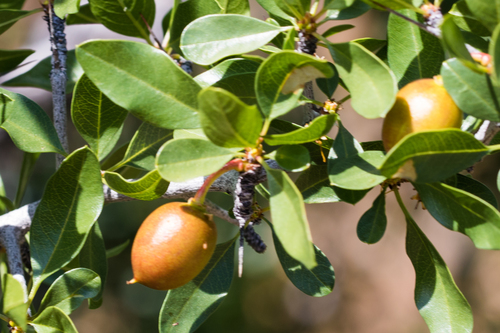
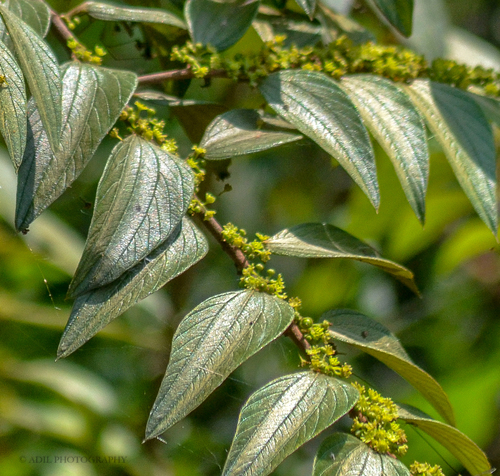
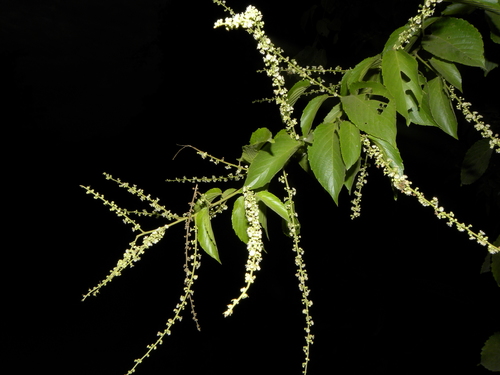
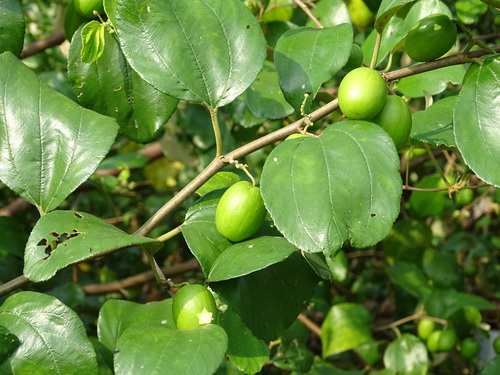
Botany Ziziphus mauritiana (also called ber) has a rapidly growing taproot, an adaptation it needs to survive drought. This species ranges widely in height: it can grow as a bushy shrub 1.5–2 metres (4.9–6.6 ft) tall, or as a tree reaching 10–12 metres (33–39 ft) tall with a trunk diameter around 30 centimetres (12 in). Z. mauritiana may grow with an erect form or have a wide-spreading habit, with gracefully drooping thorny branches, zigzag branchlets, and short, sharp straight or hooked thorns; some cultivated varieties do not have thorns. Its leaves grow alternately, and are ovate or oblong-elliptic with rounded tips. Three main longitudinal veins start at the leaf petiole. Leaves measure 2.5–6.3 centimetres (0.98–2.48 in) long and 2–4 centimetres (0.79–1.57 in) wide. The upper adaxial leaf surface is dark green and smooth, while the lower abaxial surface is covered in fine hairs. The flowers are small, yellow, and have five petals, growing from leaf axils. Flowers open fully either early in the morning or later in the day, depending on the cultivar. Fertilisation depends on cross-pollination by insects drawn to the flowers' scent and nectar. The main pollinators are honeybees, wasps of the genus Polistes, and houseflies. Because the flowers are protandrous (anthers mature before stigmas), Z. mauritiana trees cannot reliably self-pollinate. The flowers have an unpleasant scent caused by skatole, a volatile organic compound released in high concentrations when flowers open. This fast-growing species bears fruit within three years of planting. The fruit is a drupe that can be oval, obovate, round or oblong, typically around 2.5 centimetres (0.98 in) across; some cultivars produce fruit up to 6 centimetres (2.4 in) long and 4 centimetres (1.6 in) wide. Unripe fruit has light green skin, white crispy flesh, and a flavour that can be bland, sour or slightly sweet. Ripe fruit has a pleasant aroma, soft, juicy and somewhat mealy texture, wrinkled skin, and a sweet-sour taste. Overripe fruit becomes more wrinkled, with soft, spongy buff-coloured flesh and a musky scent. Each fruit holds an oval or oblate rough-textured pit that contains one or two ellipsoid red-brown kernels, each measuring 6 millimetres (0.24 in) long.
Origin and Distribution Ziziphus mauritiana is thought to be native to South Asia, southern China, Southeast Asia, and Central and West Africa. It has been introduced to tropical regions of the Americas, and is now widely naturalised across the Old World tropics, ranging from Southern Africa through the Middle East to South Asia and China, extending into Australasia and the Pacific Islands. While the Rhamnaceae family includes many nitrogen-fixing species, Z. mauritiana can form dense stands and become invasive in some areas, including Fiji and Australia, where it is classified as a serious environmental weed. Its species epithet mauritiana likely refers to the island of Mauritius, even though the species is not native there; this association developed because of trade routes and movement of plant specimens through the region in the 18th century, when Mauritius was an important colonial hub. Historically, when new species were formally described, they were often linked to the nearest or most prominent landmasses known at the time of discovery, rather than the exact location where the species was originally collected.
Ecology This hardy tree tolerates extreme temperatures and grows well in both dry and waterlogged conditions, in areas with annual rainfall between 125 and 2,225 millimetres (4.9–87.6 in). In Fiji, naturalised Z. mauritiana trees grow along roadsides and on agricultural land, usually near sea level, and occasionally up to 600 metres (2,000 ft) elevation. It also grows well on well-drained laterite soils, as well as sandy, gravelly, alluvial soils of dry riverbeds. In Australia, this species grows across a wide range of soil types, including cracking clays, solodic soils and deep alluvials, in tropical and subtropical regions with an average annual rainfall of 470–1,200 millimetres (19–47 in). In the drier parts of this range, it grows best in riparian zones. Commercial cultivation of Z. mauritiana typically occurs up to 1,000 metres (3,300 ft) elevation; above this elevation, trees do not grow well and cultivation is not as economical. Though the species can tolerate a wide range of rainfall conditions, it is most widespread in areas with 300–500 millimetres (12–20 in) of annual rainfall. In China and India, wild populations grow up to 1,650 metres (5,410 ft) elevation. The minimum temperature for species survival is 7 °C (45 °F) and the maximum is 50 °C (122 °F). Studies have found that Z. mauritiana thrives in alkaline soils with a pH as high as 9.2, but deep sandy loam to loam soils with neutral or slightly alkaline pH are considered optimal for growth.
Cultivation and Uses Ziziphus mauritiana is widely cultivated across its native and introduced ranges, primarily for its fruit. The main fruit producing regions are the arid and semi-arid areas of India. The crop is also grown in Pakistan, Bangladesh, Vietnam, the Caribbean, and parts of Africa. Between 1984 and 1995, improved cultivars produced 0.9 million tonnes of fruit across 88,000 hectares (220,000 acres) of growing land. A prime-bearing tree between 10 and 20 years old in northern India can yield 80–200 kilograms (180–440 lb) of fresh fruit per year. The fruit is eaten raw, used in beverages, or processed into preserves. It is high in vitamin C: its vitamin C content is second only to guava, and much higher than that of citrus fruits and apples. Unripe fruit is eaten similarly to apples, sometimes with a small amount of salt added. In India, ripe fruits are eaten raw or cooked, while slightly underripe fruits are candied. Ripe fruits can be made into a drink, or preserved by sun-drying and ground into powder. In Indonesia, the leaves are used to make an herbal infusion. In Venezuela, the fruit is used to make a liqueur called crema de ponsigue. Seed kernels are eaten during periods of famine. The leaves are also consumed as fodder by camels, cattle and goats. In India and Queensland, Australia, the flowers are a nectar source for honeybees. The resulting honey is golden amber with a malty, earthy flavour. The timber is hard, strong, fine-grained, fine-textured, durable, and reddish in colour. It is used for many purposes, including boat ribs, agricultural tools, and footwear. The wood is also used as fuel in many regions. In tropical Africa, the flexible branches are wrapped as retaining bands around the conical thatched roofs of huts, and twisted together to build thorny corral walls to contain livestock. Traditional medicine uses Z. mauritiana to treat a wide range of ailments, especially in India where the plant is commonly called ber. A poultice made from Z. mauritiana leaves, Z. mauritiana roots, and Senna auriculata roots is applied to the affected area to treat rheumatism. Chronic coughs are treated with bark paste fried in ghee, taken with a small amount of rock salt. Vomiting is treated by consuming root-bark powder mixed with water left from washing rice. Leaf juice is gently applied around the eyes to treat eye disorders, and is also used in hair care: a paste made from ber, amla (Phyllanthus emblica) and neem (Azadirachta indica) leaves is applied to the scalp. A leaf poultice is applied topically to treat wounds, pimples, acne, abscesses, boils and carbuncles. Indigestion is treated by taking root paste orally, while dried leaf powder is traditionally used to manage diabetes. A leaf decoction is used as a hair wash, and also used as a diuretic to manage fluid retention, oedema, sciatica, kidney stones, lymphatic swelling, glaucoma and liver disorders. For diarrhoea, powdered dried fruit is taken with water. For dysentery, leaf juices from patharchatta, jamun and ber are taken together. In West Bengal, the plant is offered to Goddess Saraswati, and people do not eat the fruit before this offering is made.