About Zipaetis saitis (Hewitson, 1863)
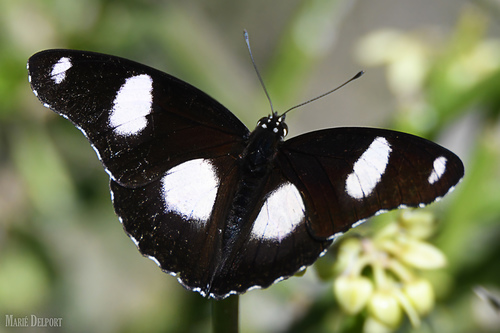
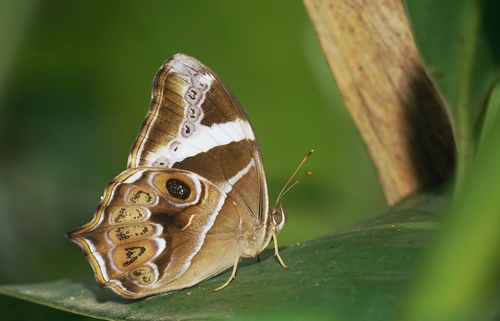
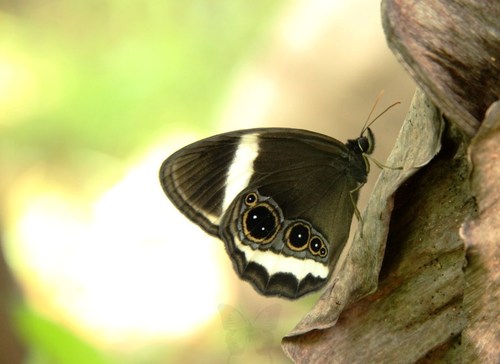
This butterfly species, Zipaetis saitis, first described by Hewitson in 1863, has the following physical characteristics. On the upperside of fresh adult specimens, males have a velvet black base color, while females range from brown to light brown. The forewing features a broad, oblique, snow-white band that stretches from the middle of the costa to near the apex of interspace 1, with an inward emargination in its lower third. The hindwing bears a similar broad white postdiscal band that runs parallel to the posterior two-thirds of the terminal margin; the outer margin of this band is emarginate between the veins. The underside pattern matches the upperside, but its ground color is paler, and the white bands are identical to those on the upperside. Both the forewing and hindwing have a subterminal sinuous pale line. On the hindwing, a row of five ocelli sits on the inner side of the white band, all enclosed within a single narrow silvery band. Each ocellus has a white center, an inner ochraceous ring, and an outer blackish brown ring. The ocelli at both ends of the row are the smallest, while the preapical ocellus is very large and has two pupils. The antennae are ochraceous red, and the head, thorax, and abdomen are dark brown. The wingspan of this species ranges from 64 to 74 mm, which equals 2.55 to 2.9 inches. Its known habitat is in Southern India, specifically the Nilgiris, Anaimalai Hills, Kochi, and Travancore.