About Zinnia peruviana (L.) L.
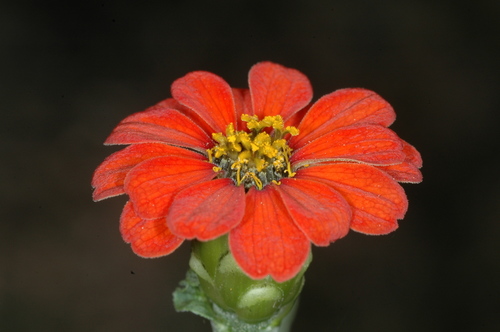
Zinnia peruviana (L.) L. is an annual plant that grows up to 50 cm tall, and rarely reaches 100 cm in height. Its stems are green when young, and later turn yellow or purple. Its leaves are ovate, elliptic, or lanceolate, measuring 2.5 to 7 cm long and 0.8 to 3.5 cm wide, with 3 to 5 visible nerves. The peduncles of this species are 1 to 7 cm long. It produces flower heads that hold 6 to 21 ray florets in shades of red, maroon, or yellow, each with a petal 0.8 to 2.5 cm long. These ray florets surround a center of 12 to 50 yellow disc florets, which have corolla lobes 0.1 cm long. Its fruits, called cypselae, are oblanceolate to narrowly elliptic, 0.7 to 1 cm long, 3-angled or compressed, and marked with striations.
The native range of Zinnia peruviana extends from southeastern Arizona and the Greater Antilles southward to Argentina. It grows most commonly in open areas or on rocky slopes, at elevations between 800 and 3000 meters. This species has been introduced to and become naturalized in many regions across the world, including China, Pakistan, India, Bangladesh, Australia, South Africa, and Hawaii.