About Zimmerius gracilipes acer (Salvin & Godman, 1883)
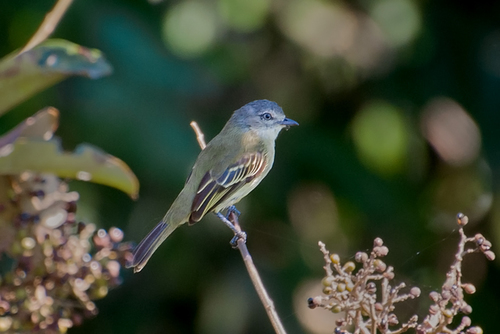
The slender-footed tyrannulet measures 9 to 12 cm (3.5 to 4.7 in) in length and weighs 6.6 to 9.5 g (0.23 to 0.34 oz). Males and females have identical plumage. Adults of the nominate subspecies have a gray forehead and crown. They have a thin whitish supercilium that begins at the lores, a dark stripe running through the eye, and an otherwise yellowish white face. Their back and rump are dull olive. Their wings are dusky, with thin yellow edges along the coverts and inner portions of the flight feathers. Their tail is dusky olive. Their throat is yellowish white, their breast is dull olive-yellow, and their belly and undertail coverts are yellow. Subspecies Z. g. gilvus has brighter yellow underparts than the nominate subspecies. Adult individuals of both subspecies have a grayish iris, a small, rounded, black bill, and dark grayish legs and feet.
The slender-footed tyrannulet is a bird native to the upper Amazon Basin. The nominate subspecies occurs in southeastern Venezuela's Bolívar and Amazonas states, extreme eastern Colombia between the departments of Vichada and Amazonas, and extends south through Amazonas state in northwestern Brazil and northeastern Ecuador into the Department of Loreto in northeastern Peru. Subspecies Z. g. gilvus is found in western and southern Brazil, from Amazonas east to the Negro and Tapajós rivers and south to the states of Rondônia and northern Mato Grosso, along the full length of central and southeastern Peru, and in northern Bolivia.
The slender-footed tyrannulet lives in humid forest across tropical to lower montane zones, and occurs in both terra firme and várzea landscapes. In unbroken forest, it most often occupies the canopy, as well as forest clearings and edges. It also lives in secondary forest and farmland that borders forest. Across most of its range, it occurs below 500 m (1,600 ft) in elevation; it only reaches 300 m (1,000 ft) in Ecuador. In Venezuela, it mostly occurs below 1,000 m (3,300 ft) but can be found as high as 2,000 m (6,600 ft). In Brazil, it is occasionally found above 500 m (1,600 ft), and it reaches 1,000 m (3,300 ft) in Peru.