About Zieria smithii Jacks.
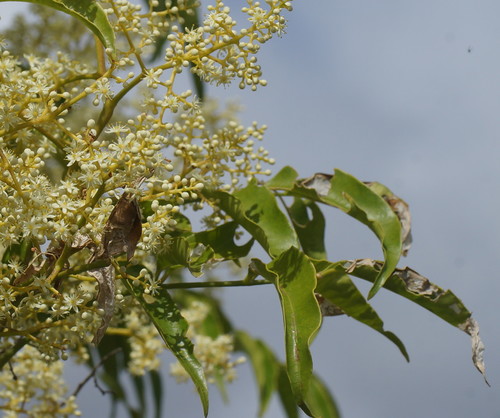
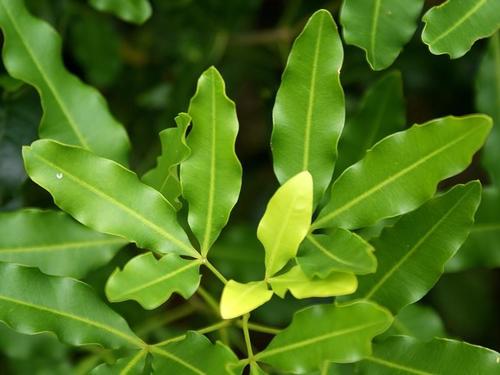
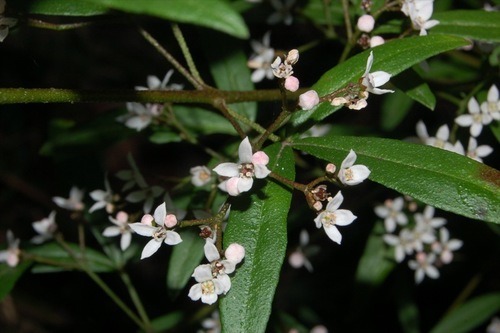
Zieria smithii Jacks. is a shrub that reaches a height of 1 to 2 meters (3 to 7 feet), and may sometimes be robust, while other individuals are spindly. This species has compound leaves made up of three leaflets. The middle leaflet is oblong to lance-shaped, measuring 20 to 45 millimeters (0.8 to 2 inches) long and 4 to 7 millimeters (0.2 to 0.3 inches) wide, with a pointed tip. The upper surface of the leaflets is darker green than the lower surface, dotted with oil glands, and mostly glabrous. The leaf stalk is 10 to 20 millimeters (0.4 to 0.8 inches) long, and crushed leaves have a strong aromatic scent. The flowers are usually white, arranged in groups of up to 60 in the upper leaf axils. These flower groups are shorter than the leaves, and each individual flower has a diameter of 6 to 7 millimeters (0.2 to 0.3 inches). There are four triangular sepal lobes, each about 1 to 1.5 millimeters (0.04 to 0.06 inches) long. The four petals are 2 to 4 millimeters (0.08 to 0.2 inches) long and slightly hairy. Like other zierias, Zieria smithii only has four stamens. Flowering takes place in autumn and spring, and is followed by a segmented capsule fruit. Each of the capsule's three or four sections holds one or two reddish brown to black striped seeds. This zieria occurs in Queensland, growing as far north as the Atherton Tableland and extending south through the Brigalow Belt, Scenic Rim and Northern Tablelands. It is widespread and common on the coast and ranges of New South Wales, but less common in Victoria. It can grow in a wide range of habitats, and is most common on the edge of rainforest, often growing in rocky areas.