About Zieria cytisoides Sm.
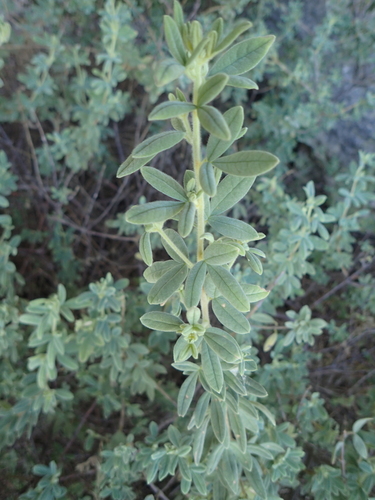
Zieria cytisoides Sm. is a bushy shrub that typically grows up to 3 metres (10 feet) in height, with branches covered in velvety hairs. Its leaves are made up of three leaflets; the central leaflet is elliptic to egg-shaped, measuring 15–40 mm (0.6–2 in) long and 4–15 mm (0.2–0.6 in) wide, attached to a petiole 3–11 mm (0.1–0.4 in) long. The leaflets are flat, though their edges sometimes roll under. The upper surface of the leaflets is dark green and covered with short, soft hairs, while the lower surface is grey-green and covered with velvety hairs.
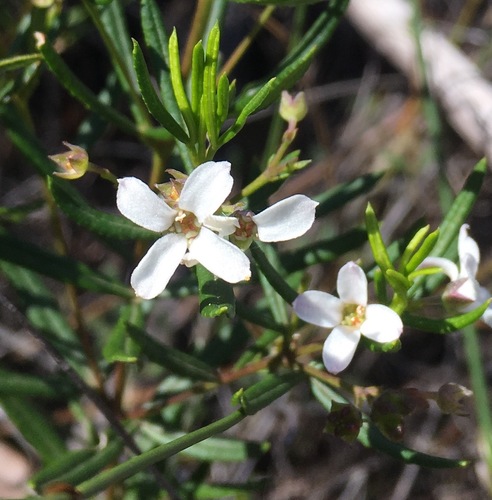
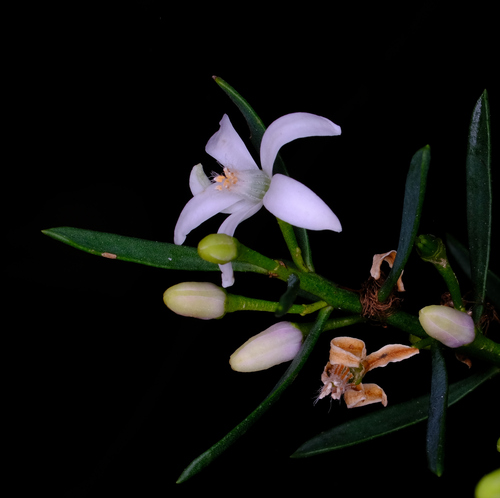
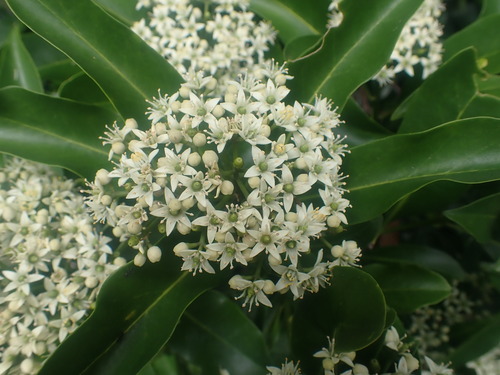
Flowers are most often pale to deep pink, and rarely white. They are arranged in clusters of 3 to 30 flowers in leaf axils, with a persistent bract 8–10 mm (0.3–0.4 in) long at the base of each cluster. The clusters are roughly the same length as the leaves, but may sometimes be longer or shorter. The sepals are triangular, around 3 mm (0.1 in) long and covered with soft hairs. The four petals are 3.5–5.5 mm (0.1–0.2 in) long, covered in soft hairs, and do not overlap one another. Each flower has four stamens. Flowering occurs in winter and spring, and is followed by velvety follicles that contain black to reddish-brown seeds.
This species occurs in Queensland, New South Wales and Victoria in Australia. It is most common and widespread in New South Wales, where it grows in forest, woodland and heath. It is often found growing in sandy soil on rocky slopes, ranging from coastal areas to the western slopes of the Great Dividing Range.
In horticulture, Zieria cytisoides is most easily propagated from cuttings. It is hardy when grown in well-drained soil in positions with full sun or part shade. At the Australian National Botanic Gardens, it grows as a compact shrub requiring little pruning, and is resistant to pests and diseases.